

A payment dispute means a customer challenged a charge and your processor has already pulled the funds provisionally, sometimes with a dispute fee attached. Your first move is not to call the customer. It’s to pull the reason code the issuer assigned and lock down every piece of evidence tied to that transaction before anything gets deleted or forgotten. The reason code tells you exactly what the issuer needs to see to rule in your favor, and it dictates everything else you do next.
TL;DR:
- The majority of successful dispute defenses depend on submitting targeted evidence matching the specific reason code, not just general proof.
- You typically have between 7 and 21 days to respond to a dispute, with most cases concluding within two to three months, making timely action crucial.
- Procedural errors, such as missing deadlines or submitting the wrong documents, cause around 40% of merchant losses in disputes.
- Physical proof like signed work orders and GPS check-ins are essential for in-person services, while activity logs and digital records are critical for remote transactions.
- Resolving disputes proactively with clear documentation and good booking practices can prevent many cases before they escalate into costly chargebacks.
Table of Contents
- What Is a Payment Dispute for Services, and Who’s Involved?
- Why Do Customers Dispute Service Charges?
- How Long Do You Have to Respond to a Dispute?
- How to Respond to a Service Payment Dispute: The Evidence Checklist
- What Does a Payment Dispute Actually Cost You?
- Preventing Disputes Before They Start
- Reducing Reconciliation Gaps With Better Booking Workflows
- What Happens If a Dispute Isn’t Resolved?
- Do Digital and In-Person Services Handle Disputes Differently?
- Can Mediation or Arbitration Resolve a Payment Dispute?
- How Do Chargebacks Affect Business Credit and Reputation?
- When Should You Refund Instead of Fight?
- How Expressbook Helps You Prevent and Win Payment Disputes
- Sources
What Is a Payment Dispute for Services, and Who’s Involved?
A dispute is not the same thing as a refund. A refund is voluntary, initiated by you. A dispute starts when a cardholder contacts their bank directly, and if the bank agrees the claim has merit, it becomes a chargeback: the transaction amount gets pulled back from your account while the case is investigated.
Five parties typically sit inside this process, and each one has a distinct job. The cardholder files the initial complaint with their bank. The issuer (the cardholder’s bank, think Chase or Capital One) reviews the claim and makes the final call. The acquirer is your bank, the one that processes your merchant account. Your payment processor (Stripe, Square, or similar) sits between you and the acquirer, formatting and submitting your evidence. The card network (Visa, Mastercard) sets the rules everyone else has to follow.
Here’s the detail most service business owners miss: your processor doesn’t decide anything. It’s a conduit. You can submit the most airtight evidence packet ever assembled, and Stripe still can’t overrule the issuing bank. The issuer makes the final determination, full stop. That single fact should change how you think about disputes. Your job isn’t to convince your processor. It’s to build a case an issuer’s review team, working through hundreds of cases a day, can approve in under a minute.
Why Do Customers Dispute Service Charges?
Service businesses run into a narrower set of dispute reasons than product retailers, but each one demands different proof. Sending a receipt when the issuer wants proof of attendance is a common way to lose a case you should have won.
The reason codes you’ll see most often break down like this:
- Fraud or unrecognized charge: the cardholder says they never authorized this payment, or don’t recognize your billing descriptor.
- Services not provided: the customer paid but claims you never showed up or delivered the work.
- Not as described: the service happened, but the customer says it didn’t match what was promised.
- Duplicate charge: they were billed twice for the same appointment or session.
- Credit not processed: they say you promised a refund and never issued it.
Each reason code wins on different evidence. “Services not provided” needs a signed work order, a completion confirmation, or a timestamped check-in log. “Not as described” needs the original service agreement and any written acceptance of terms. “Fraud” claims respond best to a documented history of prior successful transactions between that same card and your business, since Visa’s Compelling Evidence framework rewards repeat-purchase patterns.
A lot of “fraud” disputes aren’t fraud at all. They’re friendly fraud: the cardholder recognizes the charge but disputes it anyway because it’s faster than calling you for a refund, or because they’ve forgotten the appointment entirely.
Pro Tip: Match your evidence to the specific reason code, not to your general sense of what happened. An issuer reviewing “services not provided” doesn’t care that your intake form was signed if you can’t also show the technician was on-site that day.
How Long Do You Have to Respond to a Dispute?
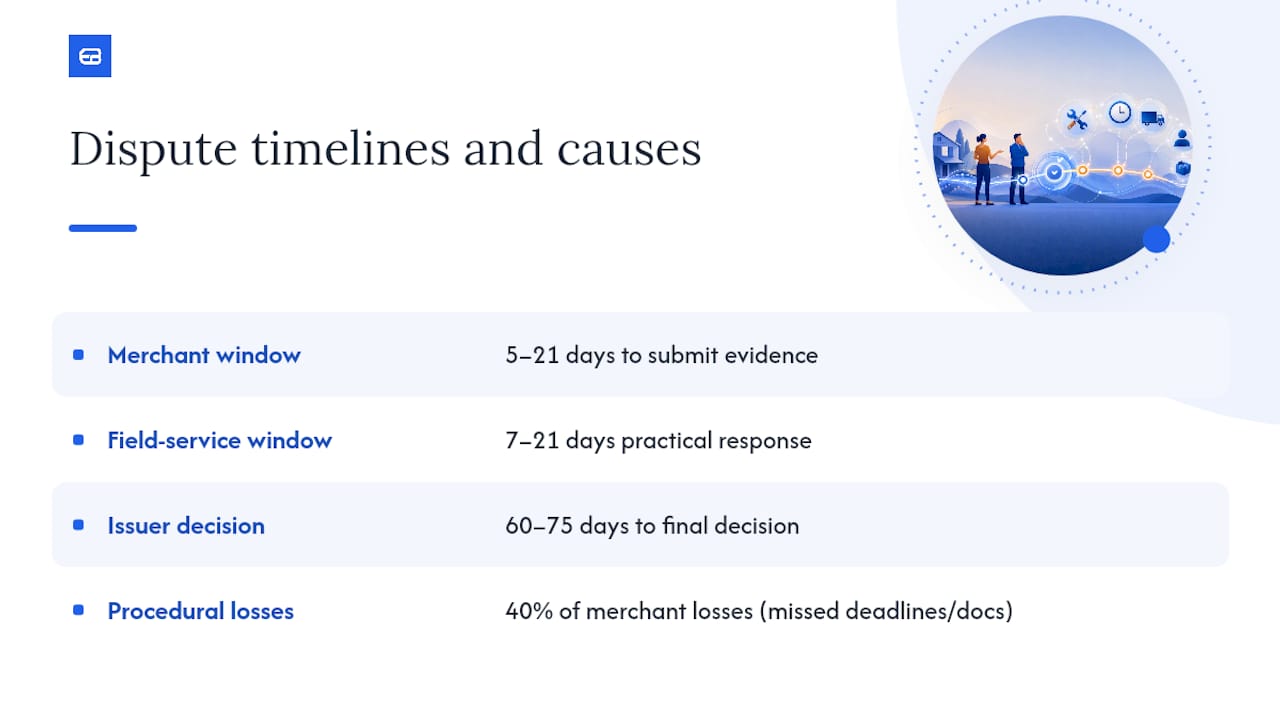
The clock starts the moment your processor notifies you, and it moves fast. Merchants typically get 5 to 21 days to submit evidence, depending on the network and case type, and the issuer then takes roughly 60 to 75 days to reach a final decision.
Field-service data puts the practical response window closer to 7 to 21 days, which means you don’t have time to “get to it next week.” Miss that window and you typically lose by default, no matter how strong your case would have been. There’s no appeal for a missed deadline. The money is simply gone, plus the dispute fee you already paid to fight it.
Roughly 40% of merchant losses in service disputes are procedural, not evidentiary, according to the same field-service playbook. That means four in ten losses happen not because the merchant was wrong, but because they missed a deadline or submitted the wrong document type. That’s a self-inflicted wound, and it’s the easiest category of loss to eliminate with a simple internal tracking habit.
Dispute volume also follows you. Card networks and processors monitor your dispute ratio, and crossing certain thresholds can push you into higher-risk monitoring programs with added fees or reserve requirements. Keeping your ratio low isn’t just about individual cases. It protects your processing relationship overall.
How to Respond to a Service Payment Dispute: The Evidence Checklist
Winning a dispute is mostly a documentation exercise, not a negotiation. Move fast and methodically.
- Read the reason code first. Don’t start gathering evidence until you know exactly what the issuer is questioning. A “duplicate charge” case needs different proof than “services not provided.”
- Freeze any pending refund action. If you were already planning to refund the customer, pause it. Issuing a refund mid-dispute can complicate or void your evidence submission.
- Pull the transaction and communication trail. Emails, texts, booking confirmations, and any customer service notes tied to that appointment.
- Assemble the core evidence packet. This includes the signed service authorization, proof of service delivery, and your refund policy language if relevant.
- Write a short cover letter. One page, plain language, walking the reviewer through the timeline in the order the reason code cares about.
- Submit as a single PDF, not a folder of loose attachments. Issuers’ review staff work through cases quickly, and a scattered submission increases the odds something gets overlooked.
Your evidence packet itself should include:
- The original signed work order or booking confirmation with the customer’s name and date
- Timestamped photos or GPS/check-in data showing the technician or provider was on-site
- Any written acceptance of your terms of service, especially cancellation and refund clauses
- Prior successful transaction history with that same card, if available
- A copy of your refund policy, highlighted at the relevant clause
Highlight the two or three sentences in each document that directly answer the reason code. Reviewers spend seconds per document, not minutes, and a highlighted excerpt does the work a cover letter can’t.
Pro Tip: Name your files so a stranger could understand your case just from the folder listing: “2026-03-14_signed_work_order.pdf” beats “scan001.pdf” every time. It also signals to the reviewer that you run an organized operation, which subtly helps your credibility.
If the case ever escalates to formal review under federal claims-and-defenses rules, note that consumer protections here apply only above a $50 threshold and when the transaction occurred in the cardholder’s home state or within 100 miles of their billing address. That geography limit surprises a lot of merchants who assume every disputed charge qualifies.
What Does a Payment Dispute Actually Cost You?
Dispute fees are non-refundable in almost every processor agreement, meaning you pay the fee whether you win or lose. That’s on top of the disputed amount itself, which stays frozen during the review window.
- Processing dispute fees typically apply per case, regardless of outcome
- Staff time spent assembling evidence is a real cost, even when it doesn’t show up on an invoice
- A high dispute ratio can push your account into stricter monitoring, sometimes with added reserve requirements
Merchants who fight disputes win roughly 45% of the time, which means the fight is worth having in most cases, but not all. Stripe’s own guidance suggests a simple math check before you commit hours to a case: if the dispute fee plus your admin time exceeds the disputed amount, accepting the loss may cost less than fighting it. For a $40 haircut dispute, that math often favors letting it go. For a $600 tattoo session or a multi-visit clinic package, it almost never does.
Preventing Disputes Before They Start
The cheapest dispute is the one that never gets filed. Most prevention comes down to closing the gap between what the customer expected and what they can prove they agreed to.
Start with your paperwork. A clear, written scope of work, signed before service begins, removes most of the ambiguity behind “not as described” claims. Your cancellation policy and refund policy should be visible at booking, not buried in an email footer nobody reads.
On the operational side, capture proof as you go. Timestamped photos, GPS check-ins, and digital signatures at completion turn a future dispute into a five-minute case instead of a scramble through old texts. A mobile app that logs this automatically at the point of service is worth more than any policy document, because it removes the human step of remembering to document anything at all.

Billing hygiene matters more than most owners realize. A vague or unfamiliar billing descriptor is one of the leading causes of “unrecognized charge” disputes; customers see a charge they don’t immediately connect to your business and dispute first, ask questions never. Booking-linked payment confirmations that reference the exact appointment date and service reduce that confusion at the source, and reviewing your PCI compliance setup for online payments closes another common gap.
Pro Tip: Send a same-day text confirmation naming the service and amount charged, in plain language. It costs nothing and it’s often the difference between a customer calling you first and a customer calling their bank first.
Reducing Reconciliation Gaps With Better Booking Workflows
Most evidence gaps trace back to disconnected systems: a booking calendar that doesn’t talk to your payment processor, which doesn’t talk to your accounting software. When those three live separately, reconstructing a dispute timeline means digging through three different logins under a deadline.
Booking-linked payment links that sync directly to QuickBooks or Xero solve this by keeping the appointment, the charge, and the customer record in one traceable chain from the moment the booking is made.
A few templates make evidence assembly close to automatic:
- A signed digital service order, captured at booking, timestamped and stored with the appointment record
- A completion confirmation the client signs or acknowledges on-site
- A standard photo checklist for field techs to capture before and after service
Field teams using a mobile app to log check-ins and photos in real time build their evidence packet passively, before any dispute is ever filed. And for clients who can’t easily complete forms or navigate a screen, a voice agent that handles bookings and answers questions by phone keeps that documentation trail intact for visually impaired customers too, instead of leaving a gap in your records for that segment of clients.
What Happens If a Dispute Isn’t Resolved?
If the issuer rules against you and you believe the decision was wrong, your options narrow but don’t disappear. Some networks allow a pre-arbitration or arbitration filing, an additional review step, though it usually carries its own fee and isn’t guaranteed to overturn the original result.
Outside the card network process, small claims court remains available for cases where the disputed amount is meaningful and you have documentation the issuer didn’t fully weigh. This works best when you have a signed contract or work order the customer is disregarding, since small claims judges respond well to paper trails.
Formal legal notice under federal billing-error procedures is a separate track from the merchant-side chargeback process, and it generally applies to the cardholder’s rights against their issuer rather than a path for merchants. Understanding FTC guidance on consumer billing protections helps you anticipate what a customer’s legal options actually look like, which shapes how aggressively you should expect them to escalate.
For recurring high-value clients, a direct conversation often resolves more than any formal process. If a client disputes a charge instead of calling you, that’s frequently a relationship signal as much as a financial one. A phone call acknowledging the issue, paired with your documented evidence, sometimes gets a customer to withdraw the dispute before the issuer even rules, which saves both the fee and the standing relationship.
Do Digital and In-Person Services Handle Disputes Differently?
Yes, and the gap is bigger than most owners expect. In-person services have a structural advantage: physical proof. A technician’s GPS ping, a signed intake form, a before-and-after photo taken on location all carry weight an issuer can visualize concretely.
Digital and remote services (online coaching, virtual consultations, subscription-based access) lack that physical anchor, so the evidence burden shifts almost entirely to activity logs. Login timestamps, session recordings where applicable, delivered content logs, and email exchanges confirming access become the equivalent of a GPS check-in.
Hybrid services, a therapist doing both in-office and telehealth sessions, for example, need both evidence types ready depending on which format the disputed session used. Trying to submit an in-person evidence template for a virtual session (or vice versa) is one of the quieter ways merchants lose cases they should win, simply because the proof doesn’t match the delivery method the issuer is evaluating.
Subscription and membership-based services carry their own wrinkle: disputes here often center on “I forgot to cancel” rather than “the service wasn’t delivered.” That shifts the winning evidence toward proof of clear cancellation terms and advance billing notices, rather than proof of service delivery itself.
Can Mediation or Arbitration Resolve a Payment Dispute?
Card network dispute resolution is technically a form of arbitration already: the issuer and acquirer submit competing evidence, and a neutral process (governed by network rules) decides the outcome. But that’s not the only path available, particularly for higher-value service contracts.
Mediation works best before a formal dispute is even filed, when a customer is unhappy but hasn’t yet called their bank. A neutral third party or even a straightforward internal escalation process (a manager stepping in, rather than the original service provider) can resolve friction that would otherwise turn into a chargeback.
For contracts with a meaningful dollar value, some service agreements include a binding arbitration clause that routes disagreements away from both small claims court and the card network process entirely. This is more common in higher-ticket service categories like extended wellness packages, contracted therapy programs, or multi-session fitness memberships, where the value at stake justifies a formal clause.
The practical takeaway for most service businesses: mediation is nearly free and works best proactively, while formal arbitration clauses only make sense once your average transaction value is high enough to justify the legal overhead of drafting and enforcing one.
How Do Chargebacks Affect Business Credit and Reputation?
Chargebacks don’t report to personal or business credit bureaus the way a missed loan payment does, so a single dispute won’t show up on your credit report. The damage runs through a different channel: your standing with your payment processor and acquiring bank.
Cross a dispute-ratio threshold set by the card networks, and you can land in a monitoring program that adds fees, reserve requirements, or in serious cases, processing account termination. Losing your merchant account entirely is a far more disruptive credit event than any single missed payment, because rebuilding a processing relationship from scratch, often at worse rates, takes months.
Reputation risk runs alongside that financial risk. A pattern of disputes, even ones you win, signals to customers (and sometimes to review platforms) that expectations aren’t being set clearly at the point of sale. Clear billing descriptors and transparent policies protect more than your dispute ratio; they shape how customers perceive your business online before they ever pick up the phone to complain.
When Should You Refund Instead of Fight?
A goodwill refund beats a fight when the relationship is worth more than the dollar amount, or when your own records are thin. Clear communication and tight documentation prevent most disputes from ever reaching that choice. Track why disputes happen, not just how you win them; recurring reason codes usually point to a fixable gap in your booking or delivery process.
— serge
How Expressbook Helps You Prevent and Win Payment Disputes
Expressbook gives you something a general payment processor can’t: a booking record, a payment, and a service confirmation that are already linked together before a dispute ever gets filed. Instead of reconstructing a timeline from three different tools under a 7 day deadline, you pull one record that already shows the appointment, the signed terms, and the payment sync to QuickBooks or Xero.
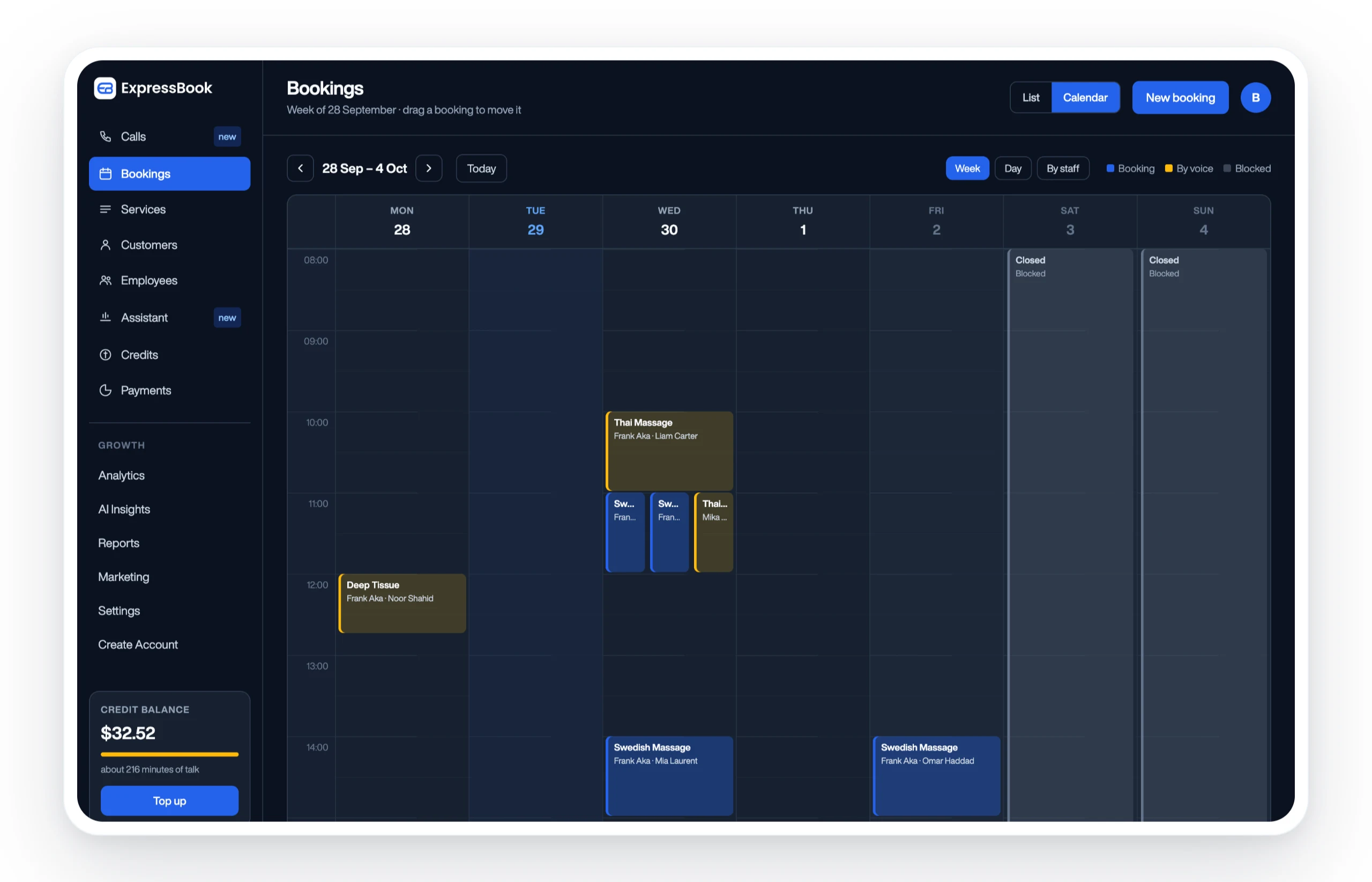
The dedicated mobile app lets field staff capture timestamped photos and completion confirmations on-site, building your evidence packet automatically instead of after the fact. The built-in voice agent supports bookings and answers questions by phone, keeping that documentation trail complete for more customers. And because reconciliation gaps are one of the biggest reasons merchants lose disputes on procedure alone, syncing bookings, payments, and client records into one system closes that gap before it costs you a case.
Expressbook has no subscription, so a small credit top-up is enough to test the booking, payment, and evidence workflow on real appointments. See how Expressbook works and start building a cleaner evidence trail from your very next booking.
Sources
- 15 U.S.C. §1666i — Assertion by cardholder against card issuer of claims and defenses arising out of credit card transaction
- Introduction to payment disputes | Stripe
- What to Do When a Customer Files a Chargeback (The Field Service Playbook, 2026)