

PCI DSS governs any business that stores, processes, or transmits cardholder data online, and every merchant falls somewhere on its compliance ladder. The fastest way to shrink your burden is architectural, not procedural: route card data through a PCI-validated, tokenized payment integration so raw numbers never touch your servers. Do that correctly and you typically qualify for the lightest self-assessment questionnaire instead of the most demanding one.
TL;DR:
- Choosing a payment integration method that routes card data through a PCI-validated provider can limit the scope to a lighter self-assessment category.
- Merchants using hosted pages, embedded fields, or SDKs handled by providers generally qualify for SAQ A or A-EP, reducing compliance complexity.
- Full capture of raw card data on your servers typically forces a more demanding SAQ D validation, significantly increasing costs and effort.
- New PCI DSS v4.0.1 controls focus on inventorying scripts and tamper detection to prevent e-skimming attacks, affecting SAQ eligibility.
- Continuous monitoring, staff training, and validation of third-party providers remain essential for long-term PCI compliance rather than a one-time effort.
Table of Contents
- What PCI DSS Compliance Means for Online Payments
- Merchant Levels and Validation Types Explained
- How Your Payment Integration Determines Your Compliance Scope
- The 12 PCI DSS Requirements, Translated for E-Commerce
- A Step-by-Step Roadmap to PCI Compliance
- Third-Party Providers and Where Responsibility Actually Sits
- What PCI DSS v4.x Changes for Online Merchants
- How ExpressBook Helps Service Businesses Limit PCI Exposure
- PCI Compliance Is a Process, Not a Certificate
- Get Started With Secure, PCI-Aligned Payments
- Where to Verify These PCI Standards
- Sources
What PCI DSS Compliance Means for Online Payments
The PCI Security Standards Council (PCI SSC) maintains the Payment Card Industry Data Security Standard, or PCI DSS, and it applies to any entity that stores, processes, or transmits cardholder data (CHD) or sensitive authentication data (SAD). The zone where that data lives, flows, or gets stored is called the cardholder data environment, or CDE. Shrink the CDE and you shrink almost everything else about the compliance project.
Nearly every online merchant falls in scope, along with payment gateways, hosting providers, and any vendor whose systems touch the CDE. Outsourcing your payment processing does not remove that responsibility. Merchants remain accountable for confirming that the outsourced services they rely on meet applicable PCI requirements, which is why evidence collection matters as much as the technical build.
Compliance produces a specific paper trail:
- A Self-Assessment Questionnaire (SAQ) for merchants who qualify to self-validate.
- A Report on Compliance (ROC) for larger or more complex environments, usually completed with a Qualified Security Assessor (QSA).
- An Attestation of Compliance (AOC), the signed summary your acquirer or payment brand actually wants to see.
Acquiring banks enforce this chain, and skipping it carries real financial exposure. Breach costs, card-brand fines, and forensic investigation fees stack up fast, and the reputational damage from a public card-data incident tends to outlast the technical cleanup by years.
Merchant Levels and Validation Types Explained
Card brands and acquirers set your merchant level based mostly on annual transaction volume, and that level determines whether you self-assess or bring in outside help. Levels run from 1 through 4, with Level 1 (the highest-volume merchants) usually required to complete a full ROC through a QSA, and Levels 2 through 4 typically eligible for an SAQ, depending on the brand and acquirer’s specific rules.
For online merchants, the SAQ variant that applies depends almost entirely on how payment data flows through your systems:
- SAQ A: for merchants who fully outsource card data handling to a validated third party, typically through a redirect or hosted payment page.
- SAQ A-EP: for merchants using an iframe or hosted field embedded in their own page, where the merchant’s website still influences the payment flow even though card data doesn’t touch their servers.
- SAQ C: for merchants using a payment application connected to the internet, common in some point-of-sale-adjacent setups.
- SAQ D: for everyone else, including merchants who capture, transmit, or store card data directly through their own servers or APIs.
A QSA and a full ROC become necessary once you’re Level 1, once an acquirer requires it, or once your environment is too complex or high-risk for self-assessment. That path adds real time and cost, since a ROC engagement usually involves weeks of evidence gathering, interviews, and remediation cycles before an assessor will sign off.
How Your Payment Integration Determines Your Compliance Scope
The single biggest lever you control is the integration method you choose, because it decides which SAQ you land on before you write a line of security policy.
- Full redirect to a hosted payment page. The customer leaves your site (or the payment form loads on a domain you don’t control) and card data never reaches your infrastructure. This usually qualifies for SAQ A, the lightest validation path.
- Hosted fields or an iframe embedded in your checkout. Card fields appear to live on your page, but they’re actually rendered by the provider inside an isolated frame. Done correctly, this also often lands you on SAQ A, though some implementations shift you to SAQ A-EP depending on what your own JavaScript touches.
- Mobile SDKs from a payment provider. Similar logic applies. If the SDK handles card capture and tokenization internally and your app never sees the PAN, you generally stay within the provider’s validated scope.
- Direct API capture. If your servers receive raw card numbers, even briefly, before sending them to a processor, you’re generally looking at SAQ D, the most demanding self-assessment, covering nearly all 12 PCI DSS requirements.
Edge cases matter here. Terminal-connected setups (physical card readers tied to internet-connected software) often fall under SAQ C. And a hosted field can quietly lose its SAQ A eligibility if your own site’s code manipulates or interacts with the payment form in ways the provider didn’t explicitly document and approve.
Whichever pattern you pick, you need paperwork to back it up. Merchants relying on a third party’s embedded solution should collect that provider’s Attestation of Compliance and written implementation instructions as proof they followed the integration exactly as validated. Without that evidence, your acquirer has no way to confirm your lighter SAQ actually applies.
Pro Tip: Ask your payment provider directly for their AOC and implementation guide before you build anything. Retrofitting compliance evidence after your checkout is live almost always costs more than designing around it from day one.
The 12 PCI DSS Requirements, Translated for E-Commerce
The PCI SSC’s official standards library organizes PCI DSS into 12 requirement areas. Read as bureaucratic categories, they sound abstract. Read as engineering tasks, they get concrete fast.
- Build and maintain a secure network. Firewall rules and network segmentation that isolate your CDE from the rest of your infrastructure.
- Protect stored cardholder data. Tokenize instead of storing PANs directly, and encrypt whatever sensitive data you must retain.
- Encrypt transmission of cardholder data. TLS everywhere card data moves, no exceptions for internal traffic.
- Maintain a vulnerability management program. Patch cadence, antivirus or anti-malware tooling, and secure coding practices for anything touching the payment flow.
- Implement strong access control. Role-based access, least-privilege defaults, and unique credentials for every system user.
- Regularly monitor and test networks. Logging, file integrity monitoring, and quarterly vulnerability scans through an Approved Scanning Vendor (ASV).
- Maintain an information security policy. Written policies, staff training, and incident response procedures that people actually follow.
For most online merchants, two areas eat the most engineering time: protecting stored data (because tokenization architecture takes real planning) and the monitoring and testing requirements, since ASV scans and log review are ongoing operational work, not a one-time checkbox. The PCI DSS v4.x compliance guide notes that script inventory and tamper-detection controls, discussed further below, have become one of the most commonly failed items during assessment.
A Step-by-Step Roadmap to PCI Compliance
Treat this as a project with phases, not a single audit event.
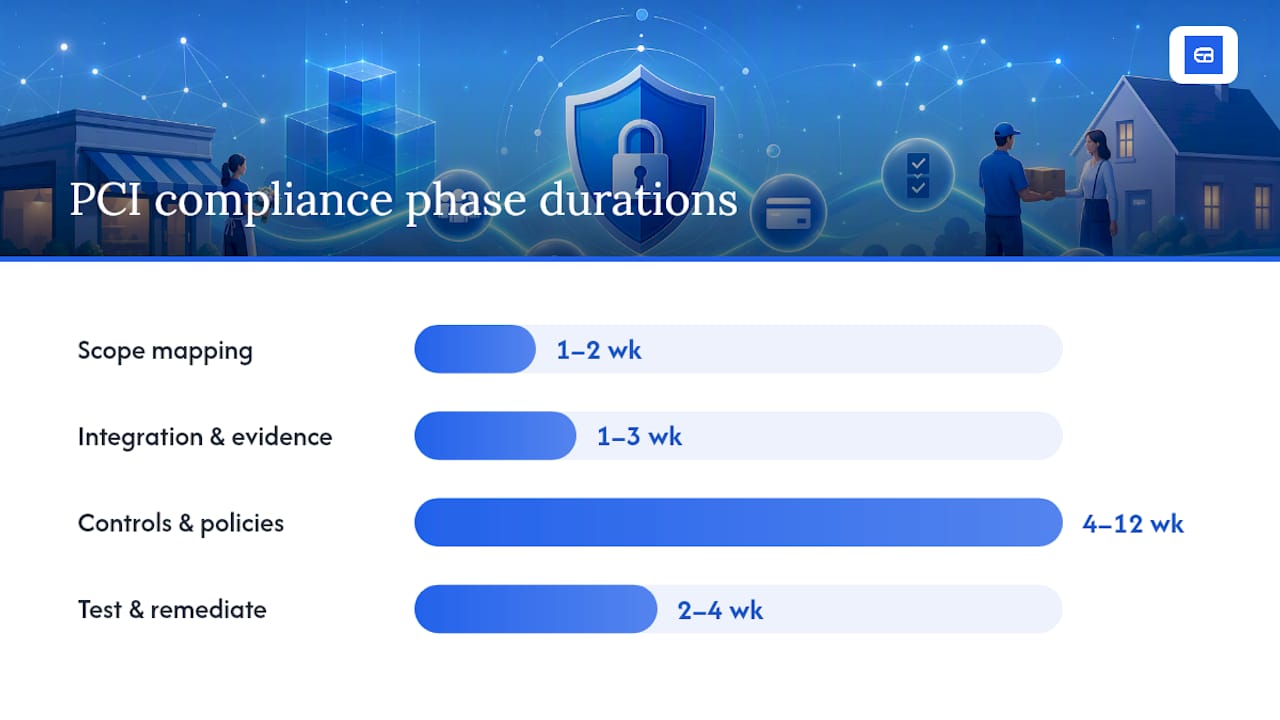
- Map and minimize scope (1-2 weeks). Diagram every place cardholder data enters, moves through, or exits your systems. The goal is finding ways to shrink the CDE before you spend a dollar on controls.
- Choose an integration approach and collect provider evidence (1-3 weeks). Lock in your hosted-field, redirect, or SDK strategy, then request the provider’s AOC and implementation documentation immediately, not after launch.
- Implement controls and policies (4-12 weeks, depending on starting point). Tokenization, encryption, multi-factor authentication (MFA), tamper-detection on payment pages, and the written security policies required under Requirement 12.
- Test and remediate (2-4 weeks). Run ASV scans, internal vulnerability reviews, and, if your level requires it, a penetration test. Fix what fails before you move to validation.
- Validate and maintain (ongoing). Complete your SAQ or, if applicable, engage a QSA for a ROC. Submit your AOC to your acquirer, then schedule revalidation, typically annually, alongside continuous monitoring.
Cost and time vary widely by starting point. A merchant already using hosted fields with clean documentation might complete an SAQ A in a few weeks with minimal spend. A merchant capturing card data directly and pursuing SAQ D or a full ROC should budget several months and, if a QSA is required, real assessment fees on top of remediation costs.
Pro Tip: Run your ASV scan and internal review before you think you’re ready, not after. Finding a gap two weeks before your acquirer’s deadline turns a manageable fix into a scramble.
Third-Party Providers and Where Responsibility Actually Sits
Relying on a validated provider reduces your scope, but it doesn’t erase your responsibility. Merchants remain on the hook for confirming that outsourced services actually meet PCI requirements, not just for assuming they do because a vendor claims compliance somewhere in their marketing copy.
Documents worth demanding before you sign a payment provider contract:
- The provider’s current AOC, showing their own PCI validation status.
- Written implementation instructions, so you can prove you followed their guidance exactly.
- Evidence the provider itself undergoes regular ASV scans and, where applicable, QSA assessment.
- A listed reference to validated payment software, if their solution appears on PCI SSC’s validated products list.
Your contract or SLA should also spell out breach notification timelines, audit rights, and a change-control process for anything touching your payment pages. A provider that can silently alter how their hosted field behaves, without notifying you, puts your SAQ eligibility at risk without your knowledge. For a broader look at implementation checklists and vendor accountability, the PCI DSS compliance guide from Secure Techie walks through practical contract language worth borrowing.
What PCI DSS v4.x Changes for Online Merchants
PCI DSS v4.x introduced controls aimed directly at e-skimming, the practice of injecting malicious code into checkout pages to steal card data in real time. Two requirements matter most for e-commerce teams.
- Requirement 6.4.3 requires you to inventory and explicitly authorize every script running on your payment pages. No more unreviewed third-party tags quietly loading on checkout.
- Requirement 11.6.1 mandates tamper-detection mechanisms that alert you when a payment page’s structure or scripts change unexpectedly.
Both exist because e-skimming attacks were a direct driver behind the new controls, and assessors are treating them as high priority. Alongside these, updated multi-factor authentication requirements (8.4.2 and 8.5.1) now apply more broadly to anyone accessing the CDE, closing a gap that let single-factor credentials guard sensitive systems.
Here’s the part that catches merchants off guard: if you can’t demonstrate your site is protected against script-based tampering, you can lose SAQ A eligibility entirely and get pushed into SAQ A-EP or higher. A quick verification checklist for web and security teams:
- Confirm every script on the checkout page is documented and approved.
- Verify tamper-detection is active and alerting correctly.
- Reconfirm MFA covers every path into the CDE, not just the obvious ones.
- Re-request your payment provider’s current AOC if it’s been more than a year.
How ExpressBook Helps Service Businesses Limit PCI Exposure
Service businesses taking online payments face the same scope problem as any e-commerce site, just with less security staff to solve it. ExpressBook’s payment flow uses a tokenized UI, so card data never lands on a business’s own servers, and everything reconciles automatically with QuickBooks and Xero, cutting the manual entry that usually accompanies payment reporting.

Resources like the HIPAA appointment scheduling guide and the payment failure reduction playbook show how ExpressBook documents its own compliance posture for customers who need to prove it to their own auditors or acquirers. A practical checklist: collect ExpressBook’s AOC, keep records showing you followed the implementation instructions exactly, and log any change made to your booking or payment pages. Using a validated vendor narrows your scope considerably, but it never fully removes your obligation to validate the requirements still sitting on your side of the line.
PCI Compliance Is a Process, Not a Certificate
PCI compliance rewards businesses that treat it as continuous risk management rather than an annual paperwork sprint. The SAQ you file in January means little by June if nobody’s watching for a rogue script on your checkout page or an access control that quietly loosened.
Staff training, periodic reassessment, and genuine ownership of Requirement 12’s policy work matter as much as any firewall rule. File your AOC, then keep working the same way you did the week before you filed it.
— serge
Get Started With Secure, PCI-Aligned Payments
Choosing the right integration path is most of the PCI battle, and ExpressBook is built to make that choice easy for service businesses that would rather focus on clients than checkout code. Its tokenized, pre-built payment UI keeps card data off your servers by design, syncs automatically with QuickBooks and Xero, and comes with a dedicated mobile app for for both staff and administrators, so payment status and bookings stay visible wherever you’re working.
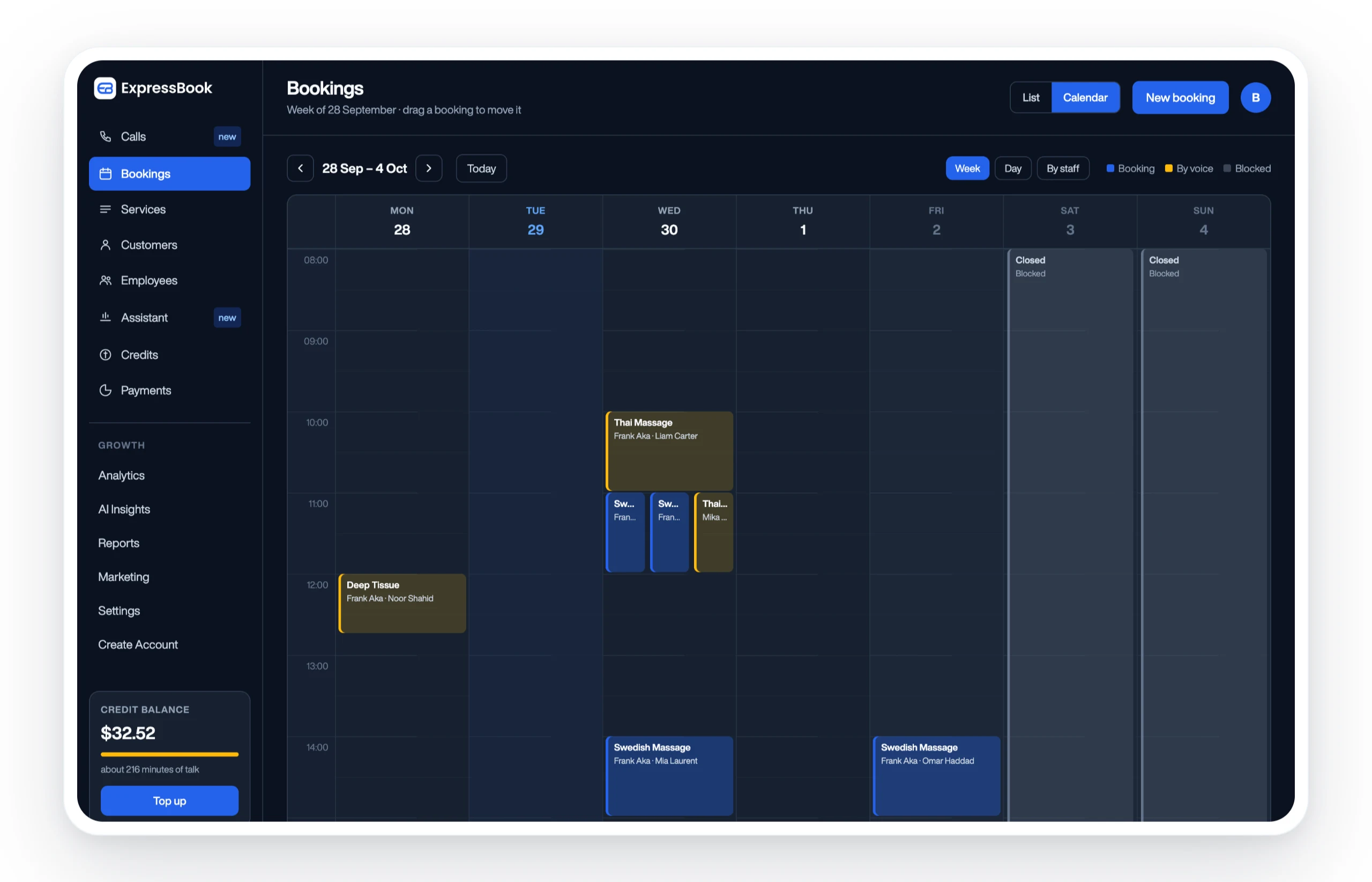
The platform also includes a voice agent that lets visually impaired clients book appointments and get answers to business questions without needing a screen, extending accessible service alongside secure payment handling. Because the payment layer follows the provider’s validated implementation pattern, businesses using ExpressBook typically collect far less evidence and manage a far smaller footprint than those capturing card data directly. Test it yourself: ExpressBook has no subscription, so a small credit top-up is enough to see the setup, and the ExpressBook platform is the fastest way to start.
Where to Verify These PCI Standards
The claims in this guide trace back to primary standards bodies and vendor documentation worth bookmarking directly.
- The PCI SSC standards library for the official 12 requirements, SAQ templates, and assessor listings.
- Stripe’s PCI compliance guide for integration-specific SAQ mapping and provider attestation guidance.
- The PCI DSS 4.0.1 compliance guide for a detailed breakdown of the v4.x e-commerce controls.
- Secure Techie’s PCI DSS overview for contract and vendor accountability checklists.
Sources
- What is PCI DSS compliance? | Stripe
- Payment Card Security Standards (PCI SSC) – Standards
- PCI DSS 4.0.1 Compliance Guide: Every Requirement That’s Now Mandatory
- Payment Card Industry Data Security Standard (v4.0.1) – Supporting document