

Mindbody earns solid mid-range scores across major review platforms, averaging 4.0/5 on Capterra from 2,978 reviews and 3.7/5 on G2 from 510 reviews, reflecting a platform that works well for established studios but frustrates smaller operators. The consensus across Mindbody user experiences is consistent: powerful feature depth, real marketplace exposure, and genuine scheduling capability on one side; pricing complexity, contract rigidity, and inconsistent customer support on the other.
Who benefits most: Multi-location fitness studios and established wellness businesses that actively use the Mindbody consumer marketplace for client acquisition. Who struggles most: Solo operators and small studios with lean admin capacity who need simple, low-friction scheduling without a steep learning curve.
Notable alternatives worth evaluating include Mangomint for team-based salons, GlossGenius for solo beauty professionals, and Expressbook for businesses that want modern AI-powered analytics, QuickBooks/Xero accounting sync, and a clean booking experience without the contract complexity.
- Mindbody marketplace represents a significant user base, offering a genuine acquisition channel for studios with the staff to leverage it.
- Pricing starts at a base monthly rate but meaningful marketing tools require higher-tier plans.
- Customer service ratings show mixed feedback, with users citing inconsistent support quality.
- Annual contracts with early termination policies are standard, which may limit flexibility.
Pro Tip: Before signing any annual contract, build a 12-month cost model that includes the base plan, payment processing fees, messaging costs, add-ons, and potential termination fees. The monthly sticker price rarely reflects total cost.
Table of Contents
- What do Mindbody reviews actually say about ratings and support?
- How does Mindbody pricing actually work for small businesses?
- Expert perspective: who should use Mindbody and when to look elsewhere
- What real users say about Mindbody across different industries
- How does Mindbody perform feature by feature?
- What integrations does Mindbody support?
- How does the Mindbody mobile app perform for business owners?
- What updates and roadmap changes affect Mindbody usability in 2026?
- Expressbook gives you a modern alternative without the contract risk
- Key Takeaways
What do Mindbody reviews actually say about ratings and support?
| Platform | Overall Rating | Ease of Use | Customer Service | Reviews |
|---|---|---|---|---|
| Capterra | 4.0/5 | 4.0/5 | 3.8/5 | 2,978 |
| GetApp | 4.0/5 | 4.0/5 | 3.8/5 | 2,990 |
| G2 | 3.7/5 | Not listed | Not listed | 510 |
| Trustpilot | 3.8/5 | Mixed | Mixed | 510 |
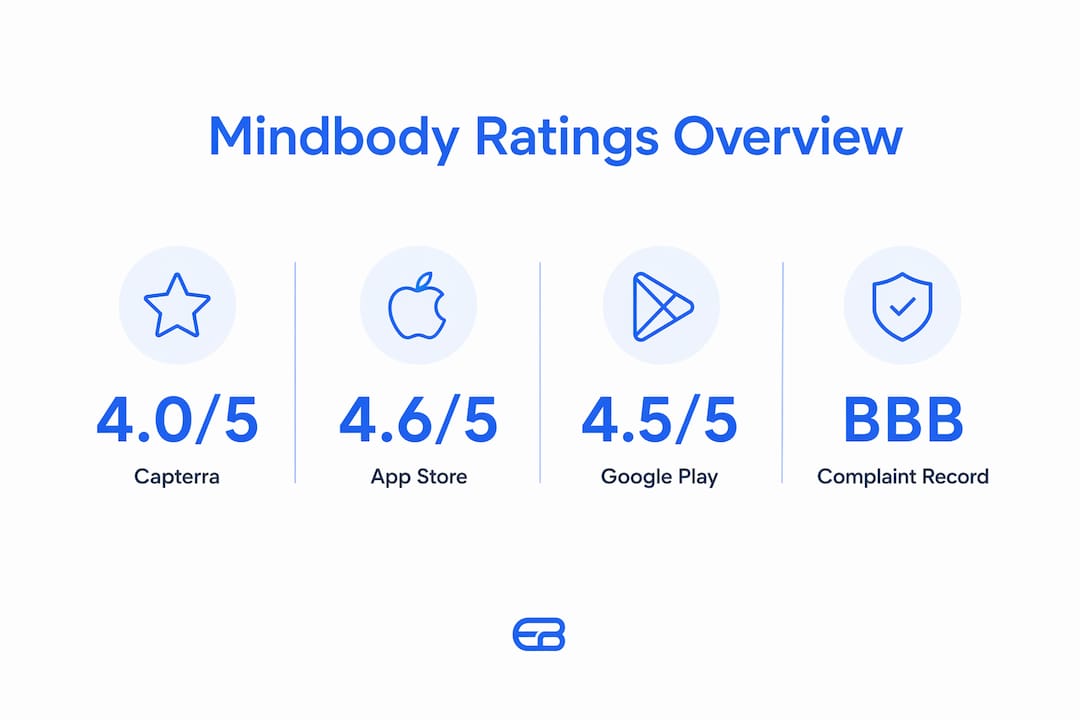
The Capterra review profile shows a clear split between users who praise booking management, class scheduling, and payment integration, and those who flag navigation complexity, glitches, and support inconsistencies. GetApp’s summary echoes this: strong scheduling and payment processing, but complexity, bugs, and unpredictable pricing costs surface repeatedly in critical feedback.
Customer support is where Mindbody service ratings take the most consistent hits. Capterra’s customer service score sits at 3.8/5 across 2,991 reviews, and users frequently describe having to re-explain their issues to different agents each time they call. Stateside support is only available on Ultimate and Ultimate Plus plans; Starter and Accelerate users are routed to outsourced support teams.
Key stat: GetApp lists Mindbody’s value-for-money score at just 3.6/5, the lowest sub-rating on that platform, which tells you something about how users weigh cost against what they receive.
The Better Business Bureau complaint record adds important context. BBB filings from 2026 include complaints around billing disputes, cancellation difficulties, and onboarding gaps. These are not product-rating complaints; they reflect contract and billing process concerns that prospective buyers should research before committing.
How does Mindbody pricing actually work for small businesses?
Mindbody’s pricing starts at $99/month per location for the Starter plan, but that number understates what most studios actually spend. The three main tiers are Starter, Accelerate, and Ultimate, with an Enterprise option for franchises and multi-location operators.

The critical detail: marketing automation, retention analytics, and automated email and text campaigns are locked behind the Ultimate tier, which starts at $399/month or higher. Accelerate adds room and resource management and promo codes, but the full marketing suite requires the top tier.
Beyond the base plan, total cost depends on:
- Payment processing fees on every transaction
- Messaging fees for SMS and email campaigns
- Branded app add-on for studios wanting a white-labeled client app
- Discovery booking fees when new clients find you through the Mindbody marketplace
- Multi-location management costs for studios running more than one site
- Annual contract commitment with early termination fees if you exit before the 12-month term ends
For a small studio on the Starter plan that adds messaging and payment processing, the real monthly outlay often lands well above the advertised starting price. Studios considering the marketing suite should model the Ultimate tier plus add-ons from day one, not the Starter price.
Expert perspective: who should use Mindbody and when to look elsewhere
Industry analysis consistently positions Mindbody as the right fit for established fitness studios that want marketplace-driven client acquisition, multi-location controls, and deep reporting, and have the administrative capacity to manage a complex platform. The Mindbody consumer app’s 3.5 million monthly active users represent a genuine discovery channel, but marketplace competition means new bookings are not automatic.
For smaller or newer studios, the calculus shifts. The interface complexity, mandatory annual contracts, and admin demands create friction that lean teams struggle to absorb. A solo yoga instructor or a two-person medspa does not need multi-location reporting or a built-in sales pipeline; they need clean scheduling, reliable payments, and fast client communication.
Suitability checklist:
- Choose Mindbody if: You run an established studio with 5+ staff, actively use marketplace discovery, need multi-location management, and have admin capacity to configure and maintain the platform
- Consider Mangomint if: You run a team-based salon or spa and want a more modern, less complex interface
- Consider GlossGenius if: You are a solo beauty professional who manages everything from a mobile device
- Consider Expressbook if: You want AI-powered analytics, automatic QuickBooks/Xero sync, accessibility features including a voice booking agent, and a clean experience without annual contract lock-in
Pro Tip: Match your platform choice to your staffing reality, not your growth ambitions. A platform you cannot configure or maintain confidently will cost more in lost time than it saves in features.
What real users say about Mindbody across different industries
Fitness studio owners on Trustpilot describe a sharp divide between onboarding experience and long-term satisfaction. Several reviewers praise specific support representatives by name for thorough, knowledgeable guidance during setup. The frustration tends to emerge later, when day-to-day navigation proves more complex than the sales process suggested.
A medical spa owner documented signing a one-year contract specifically for marketplace client acquisition, receiving zero new clients through that channel over six months, and then struggling to get meaningful responses when raising the issue. A salon owner on the BBB complaint board described the platform as “not user-friendly for business owners” and noted that AI messenger features did not perform as advertised after purchase.
On the positive side, multi-location gym operators and established yoga studios consistently cite scheduling depth, class management, and payment integration as genuine strengths. Users managing 10+ staff members and multiple class types report that Mindbody’s infrastructure handles that complexity well once configured.
The pattern across industries: businesses with the staff and time to invest in setup and ongoing management tend to rate Mindbody higher. Those who expected a plug-and-play experience often do not.
How does Mindbody perform feature by feature?
Scheduling: Mindbody’s scheduling engine is genuinely capable, supporting multi-instructor, multi-room setups, class series, waitlists, and resource management. For complex studio operations, it handles the load. The tradeoff is interface complexity; booking and checkout require more steps than most modern alternatives.
Payment processing: Integrated payments work across in-person, online, and app-based transactions. Users report that payment deposit timing and fee transparency are common friction points, particularly for smaller studios monitoring cash flow closely.
Marketing tools: The marketing suite includes automated email and text campaigns, promo codes, retention analytics, and a built-in sales pipeline, but most of these features require the Ultimate tier. Studios on Starter or Accelerate have limited marketing automation available.
Reporting: Reporting capabilities are broad, covering revenue, attendance, retention, and staff performance. Critical reviewers note that some reporting configurations are not intuitive and require significant setup time to produce actionable outputs.
AI features: Mindbody has introduced AI-powered tools including an AI messenger, though user feedback on these features is mixed, with some users reporting that the AI messenger did not perform as described during the sales process.
What integrations does Mindbody support?
Mindbody connects with a range of third-party platforms, including Google Calendar for scheduling visibility, Zoom for virtual class delivery, and various payment processors. The platform also integrates with AI-driven scheduling tools that can complement its workforce management capabilities.
Marketing integrations include connections to email platforms and SMS providers, though some of these carry additional per-message fees. The ClassPass integration is notable given Mindbody’s acquisition of ClassPass, though several long-term users have flagged concerns about the conflict of interest this creates when ClassPass sells class spots at discounted rates.
Accounting integration is not a native Mindbody strength. Studios that need automatic sync with QuickBooks or Xero typically rely on third-party connectors or manual exports, which adds administrative overhead at month-end.
How does the Mindbody mobile app perform for business owners?
The Mindbody business app carries a 4.6/5 rating on the Apple App Store and 4.5/5 on Google Play, but those aggregate scores obscure a significant volume of one-star reviews citing crashes, login failures, and inaccurate appointment displays. Android users report more frequent issues, including random crashes and extended downtime periods.
For clients booking through the consumer-facing Mindbody app, the experience is generally functional, though the booking flow requires more steps than newer platforms. The consumer app’s 3.5 million monthly active users represent real discovery potential, but the multi-step booking process can increase drop-off rates for new clients.
Business owners on Starter and Accelerate plans also lack two-way text messaging through the app, which limits real-time client communication for studios that rely on that channel.
What updates and roadmap changes affect Mindbody usability in 2026?
Mindbody has continued adding AI-powered features to its platform, including the AI messenger and enhanced analytics tools. However, user feedback suggests that the pace of interface modernization has not kept up with feature additions. The underlying navigation structure, which multiple reviewers describe as clunky and dated, remains a consistent complaint even in 2026 reviews.
The ClassPass integration continues to evolve, with Mindbody now operating on both sides of the marketplace transaction. Studios using ClassPass for acquisition should model the revenue impact of discounted class spots against the exposure benefit.
Pricing adjustments have been a recurring theme in long-term user reviews. Several users with multi-year relationships describe annual price increases without corresponding service improvements, which affects the value calculation for studios renewing contracts.
Expressbook gives you a modern alternative without the contract risk
If the Mindbody review picture above raises questions about fit for your business, Expressbook is worth a serious look. Unlike platforms that lock you into annual commitments before you have tested the product, Expressbook has no subscription at all, so a small credit top-up is enough to validate the fit against your actual workflows.
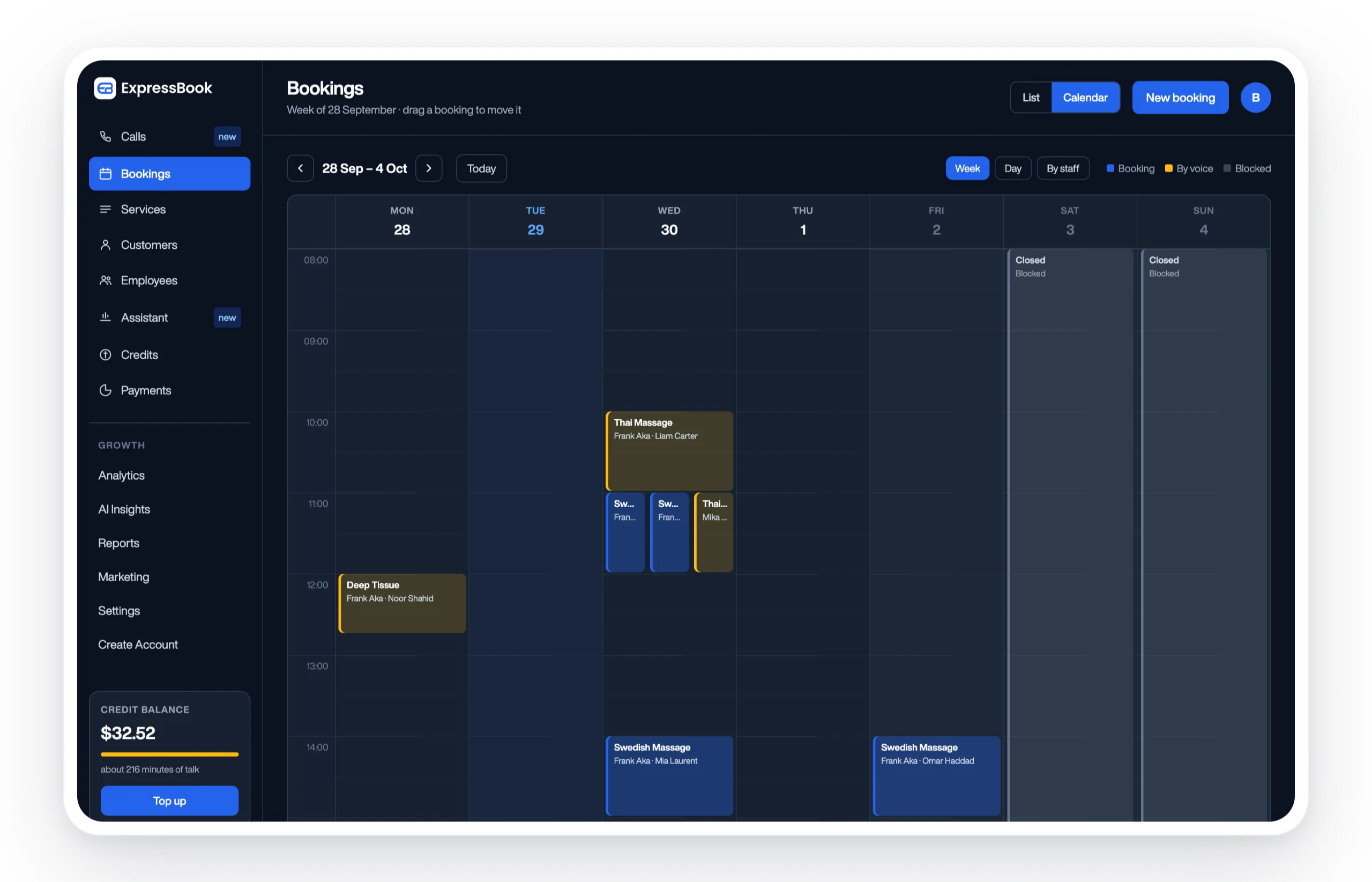
Expressbook is built for fitness, wellness, beauty, and medspa businesses that need clean appointment scheduling, automatic QuickBooks and Xero sync, and AI-powered analytics without the administrative overhead of a complex enterprise platform. The dedicated mobile app covers both client booking and admin management, and a built-in voice agent makes the platform accessible to visually impaired clients as well.
For spa and wellness operators or beauty and salon businesses that want modern tools without the contract complexity, set up Expressbook and see the difference within your first month.
Key Takeaways
Mindbody is a capable platform for established studios, but its pricing complexity, contract terms, and interface friction make it a poor fit for small or solo operators without dedicated admin support.
| Point | Details |
|---|---|
| Mixed review scores | Mindbody averages 4.0/5 on Capterra (2,978 reviews) and GetApp (2,990 reviews), but only 3.7/5 on G2 (510 reviews), with value-for-money at 3.6/5 on GetApp. |
| Pricing goes beyond $99/month | Marketing automation requires the $399+ Ultimate tier; add-ons and transaction fees increase total cost significantly. |
| Contract terms are a real risk | Annual 12-month auto-renewing contracts with early termination fees are standard, limiting flexibility for smaller studios. |
| Best fit is established studios | Businesses with staff capacity, multi-location needs, and marketplace acquisition strategies get the most from Mindbody. |
| Expressbook offers a contract-free path | Expressbook provides AI analytics, QuickBooks/Xero sync, and a voice booking agent on prepaid credits with no monthly fee. |