

For most small-to-midsize salons, spas, fitness studios, and medspas, Expressbook is the strongest Vagaro alternative available today. It combines appointment scheduling, payments, automated QuickBooks/Xero accounting sync, AI-powered analytics, and a voice agent for accessibility — all on prepaid credits with no monthly fee.
If your situation calls for something different, here are three targeted picks:
-
Mangomint — best for growing salons and spas that want polished client-facing automation and embedded website booking.
-
Mindbody — best for fitness studios and wellness businesses running class schedules, memberships, and large rosters.
-
Portrait Care — best for medspas and clinical aesthetics practices that need integrated EHR and medical compliance tools.
The full shortlist evaluated here includes: Expressbook, Mangomint, Mindbody, Square Appointments, Fresha, GlossGenius, Zenoti, Acuity Scheduling, Booksy, Portrait Care, WellnessLiving, MassageBook, Jane, Boulevard, ClinicSense, Fitune, Momence, Weave, RepeatMD, AestheticsPro, Nextech, Goldie, Carepatron, RXNT, AdvancedMD EHR, athenaOne, Elation, and Tebra.
Key Takeaways
For most small-to-midsize salons, spas, fitness studios, and medspas, the right Vagaro alternative is the one that matches your operational model — Expressbook is often the strongest starting point for operators needing accounting sync and accessibility, but alternative platforms may be preferable for medspas, class-based studios, or solo practitioners as recommended in the platform-by-business-type guide.
| Point | Details |
|---|---|
| Match platform to business model | Solo pros need simplicity; multi-location groups need centralized reporting; medspas need EHR compliance. |
| Total cost beats headline price | Always add per-staff fees, payment processing, onboarding, and add-ons before comparing platforms. |
| Test data export and mobile booking | Verify clean data portability and a frictionless client mobile experience before committing to any platform. |
| Expressbook for accounting sync | Expressbook’s automated QuickBooks/Xero sync and voice-agent accessibility distinguish it from most alternatives in this category. |
| Start small | Expressbook has no subscription, so a small credit top-up is enough to run a full parallel test before canceling Vagaro. |
Table of Contents
- Which Vagaro alternatives deserve a closer look?
- What each top alternative actually offers
- How to choose the right Vagaro alternative for your business
- How these alternatives were selected
- Migration and onboarding: practical checklist and timeline
- What Vagaro is and why businesses look for alternatives
- When to stick with Vagaro and when to switch
- Expressbook is the recommended alternative for most operators who need integrated accounting sync and accessible booking; however, depending on your business model, platforms like Mindbody (for class-based studios), Portrait Care (for medspas/clinical compliance), or Square Appointments, GlossGenius, or Goldie (for solo pros) may be a better match.
- Sources
Which Vagaro alternatives deserve a closer look?
The table below covers the 12 most relevant options across the key dimensions operators ask about. All remaining platforms are profiled in the section that follows.
Pro Tip: When comparing starting prices, always factor in per-staff fees, payment processing rates, and onboarding costs. A platform with a low headline price can cost significantly more once those components are added. Total cost comparisons must account for all these components, not just the subscription line.
What each top alternative actually offers
Expressbook targets salons, spas, gyms, fitness studios, wellness clinics, and medspas that need scheduling and accounting to work together without manual data entry. Its automated sync with QuickBooks and Xero is the clearest differentiator in this category: bookings, payments, and client data flow directly into your accounting software. The platform includes real-time availability management, AI-powered analytics, automated reminders, branded booking pages, and a voice agent that lets visually impaired clients book appointments and get answers about your business. Both admins and clients have dedicated mobile apps. There is no subscription, only prepaid credits. Best for: salons, spas, fitness studios, and medspas that want accounting sync and accessible booking in one platform.
Mangomint is a design-forward platform built around team workflows. Its embedded booking flows integrate cleanly into existing websites, and its automation tools handle staff scheduling, tip distribution, and client communications with minimal manual input. Many roundup comparisons consistently place it among the top picks for growing salons that want a polished client experience. Best for: multi-staff salons and spas prioritizing automation and a premium client-facing experience.
Mindbody is the dominant platform for class-based fitness and wellness businesses. Its marketplace drives consumer discovery, and its membership and class-pack management tools are among the deepest in the category. The tradeoff is cost and complexity: Mindbody’s pricing scales quickly, and the setup curve is steeper than most alternatives. Best for: fitness studios, yoga and Pilates studios, and wellness centers running class schedules and memberships.
Square Appointments works well for solo professionals and small teams already using Square for payments. The solo plan is free, and the payment integration is frictionless. Multi-location support and membership features are limited compared to dedicated salon platforms. Best for: solo stylists, barbers, and small teams on a tight budget.
Fresha operates on a marketplace-first model with no monthly subscription for some users, charging commissions on marketplace-sourced bookings instead. That model works well for independent operators who want discovery without upfront cost, but marketplace platforms can redirect the client relationship away from your own brand. Best for: independent salon owners and barbers who prioritize marketplace exposure.
GlossGenius offers flat-fee monthly pricing with a mobile-first design that appeals to solo beauty professionals. Its booking pages are visually polished, and the pricing is predictable. It lacks the depth for multi-location or class-heavy operations. Best for: independent stylists and solo beauty pros who want a clean, affordable booking experience.
Zenoti is built for enterprise-scale operations: multi-location chains, franchise wellness brands, and large spas. Its automation and reporting tools are extensive, and its pricing reflects that scope. Best for: large multi-location salon and spa groups.
Acuity Scheduling (now Squarespace Scheduling) is a calendar-first tool with strong embeddable booking widgets and integrations. It suits small businesses that need flexible scheduling without a full salon management suite. Best for: small businesses and solo practitioners who need calendar-centric scheduling.
Booksy combines a consumer marketplace with direct booking tools, with particular strength in the barber and men’s grooming segment. Its marketplace and local discovery features make it a natural fit for barbers seeking new clients. Best for: barbers and local salons focused on new-client acquisition.
Portrait Care is an EHR-focused platform designed specifically for medspas and clinical aesthetics practices. It offers a freemium EHR with optional premium add-ons and integrated medical oversight, making it one of the few platforms in this list built for clinical compliance. Best for: medspas and aesthetic clinics that need integrated EHR and medical record management.
WellnessLiving covers class scheduling, memberships, marketing automation, and a consumer-facing app. It competes directly with Mindbody at a lower price point and suits boutique fitness studios and wellness centers with active membership programs. Best for: boutique fitness studios and wellness centers with membership-heavy models.
MassageBook is purpose-built for massage therapists and small therapy practices. Its scheduling, client notes, and SOAP note features are tailored to the therapy workflow. Resources from AMTA often point massage operators toward therapy-specific platforms like this one when evaluating clinical scheduling needs. Best for: massage therapists and solo therapy practitioners.
Jane serves health and wellness clinics with a focus on charting, intake forms, and insurance billing. It suits practitioners who need clinical documentation alongside scheduling.
Boulevard targets upscale salons and spas with precision scheduling, two-way texting, and a strong client experience focus. G2 reviews reflect generally positive satisfaction among salon operators, though pricing is positioned at the premium end.
ClinicSense is built for massage and wellness clinics, with SOAP notes, intake forms, and insurance receipts. It overlaps with MassageBook but adds stronger clinical documentation.
Fitune focuses on fitness studios and personal trainers, with class scheduling, memberships, and a branded client app. It suits small fitness businesses that want a lightweight, mobile-friendly platform.
Momence targets fitness and wellness studios with live-streaming, on-demand content, and class scheduling. It suits studios that have added virtual programming to their in-person offerings.
Weave is a communication-first platform combining scheduling with two-way texting, phone, and review management. It suits practices where client communication is as important as booking logistics.
RepeatMD focuses on medspa and aesthetic clinic revenue, with tools for memberships, packages, and patient loyalty programs. It complements rather than replaces a full scheduling platform.
AestheticsPro is a cloud-based medspa management platform with EHR, scheduling, POS, and marketing tools built for medical aesthetic practices.
Nextech serves dermatology, ophthalmology, and plastic surgery practices with EHR, practice management, and patient engagement tools at the clinical end of the spectrum.
Goldie (formerly Appointfix) is a simple, mobile-first scheduling app for solo beauty and wellness professionals who want appointment reminders without a complex platform.
Carepatron is a health and wellness practice management platform with scheduling, client records, and billing tools suited to small therapy and wellness practices.
RXNT provides EHR, practice management, and billing software for medical practices, including those with aesthetic or wellness components.
AdvancedMD EHR is a clinical practice management platform for medical offices, including medspas with physician oversight and complex billing needs.
athenaOne is an enterprise-grade EHR and practice management system used by larger medical practices and health systems.
Elation is a primary care EHR that some integrative and functional medicine practices use alongside wellness scheduling tools.
Tebra (formed from the merger of Kareo and PatientPop) combines EHR, billing, and patient engagement for independent medical practices, including those with aesthetic services.
How to choose the right Vagaro alternative for your business
The right platform depends on your business model, team size, and the operational gaps that pushed you to look for alternatives in the first place. Growing salons and medspas often move from broad platforms to specialized software to gain automation, multi-location controls, or clinical features that entry-level tools lack.
Questions to ask every vendor during a demo
- Can I export all client data, appointment history, and product inventory in a standard format (CSV, Excel)?
- How are per-staff seat fees structured, and does the price change as I add team members?
- Does the platform support memberships and recurring billing natively, or through a third-party add-on?
- Is there a consumer marketplace, and does booking through it require clients to create an account?
- What are the payment processing rates, and can I use my existing processor?
- What is the contract length, and what are the cancellation and data-portability terms?
- Is live onboarding or data migration assistance included, or is it a paid add-on?
Matching platform type to business model
| Business Type | Platform Category | Recommended Options |
|---|---|---|
| Solo professional | Lightweight, mobile-first | Square Appointments, GlossGenius, Goldie |
| Small multi-stylist salon or spa | Full-featured, mid-market | Expressbook, Mangomint, Boulevard |
| Boutique fitness or yoga studio | Class and membership-focused | Mindbody, WellnessLiving, Fitune, Momence |
| Multi-location group or chain | Enterprise-grade | Zenoti, Expressbook, Mindbody |
| Medspa or clinical aesthetics | EHR-integrated | Portrait Care, AestheticsPro, Nextech, Expressbook |
| Massage or therapy practice | Therapy-specific | MassageBook, ClinicSense, Jane |
Red flags to watch for
- Contracts longer than 12 months with no data-portability clause.
- Marketplace models where clients are required to create a platform account to book with you — this shifts the client relationship to the platform, not your business.
- Onboarding fees that aren’t disclosed until after a demo.
- Payment processing locked to a single processor with no rate transparency.
Beyond the monthly subscription, total cost must include per-staff charges, payment processing rates, add-on modules, onboarding fees, and any marketing services. Two platforms at the same headline price can differ by hundreds of dollars per month once those components are counted.
How these alternatives were selected
This shortlist was assembled using a consistent set of criteria applied across all 29 platforms:
- Product fit: Does the platform cover the core needs of beauty, wellness, fitness, and medspa operators — scheduling, payments, client records, and reporting?
- Industry specialization: Does it serve a specific vertical (massage, clinical aesthetics, fitness classes) with purpose-built features?
- Multi-location support: Can it manage multiple sites, staff, and reporting from a single account?
- EHR and clinical features: For medspa and clinical operators, does it include or integrate with compliant medical record tools?
- Pricing transparency: Are starting prices and fee structures publicly available or disclosed during a standard demo?
- Mobile app availability: Do both operators and clients have a dedicated mobile app?
- Trial and onboarding options: Can you try it on real bookings before paying a subscription, and is there live onboarding support?
Review signals were drawn from Capterra, G2, and Trustpilot. When reading reviews on these platforms, prioritize recent verified reviews (within the last 12 months) and check whether vendors respond to negative feedback — response frequency is a reliable proxy for support quality.
Expressbook is included as the publisher’s own platform and is recommended on merit. That relationship is disclosed here transparently.
Migration and onboarding: practical checklist and timeline
Switching platforms is the part most operators underestimate. A structured migration prevents data loss and client disruption.
Step-by-step migration checklist
- Export your data from Vagaro — download client contact lists, appointment history, product inventory, staff records, and membership data in CSV format before canceling your subscription.
- Audit your client list — remove duplicates and verify contact details before importing into the new platform.
- Map your services and pricing — recreate your service menu, duration settings, and pricing tiers in the new system before going live.
- Set up staff accounts and permissions — configure each team member’s schedule, services, and access level.
- Configure payments — connect your payment processor, set deposit rules, and test a transaction end-to-end.
- Migrate memberships and packages — manually recreate active memberships or coordinate with the new vendor on bulk import options.
- Set up automated reminders — configure email and SMS reminder sequences before your first live booking.
- Test the client booking flow — book a test appointment as a client, including the mobile app path and, where available, the voice-agent path.
- Run parallel systems for one to two weeks — keep Vagaro active during the transition to catch any missed bookings.
- Notify clients — send a simple message explaining the new booking link and any changes to how they book.
Estimated timeline by business size
- Solo professional: 3–5 days for full setup and data import.
- Small multi-stylist salon (2–10 staff): 1–2 weeks, including staff training.
- Multi-location group: 3–6 weeks, with a phased rollout by location recommended.
Common pitfalls after cutover
- Forgetting to update the booking link on Google Business Profile, Instagram bio, and your website.
- Not testing the mobile client app before launch — clients who can’t book on mobile will call instead.
- Missing recurring membership billing dates during the transition window.
Pro Tip: Test the voice-agent booking path and the admin mobile app on day one with a small credit top-up. These are the two features most operators discover late, and both directly affect client retention and staff efficiency. Expressbook’s automated reminders also reduce no-shows from the first week of use.
Expressbook’s onboarding support is included on every account, and with no subscription, multi-stylist teams can run a full parallel test with a small credit top-up.
What Vagaro is and why businesses look for alternatives
Vagaro is a broad beauty, wellness, and fitness management platform that bundles appointment scheduling, point-of-sale, inventory management, payroll, and a consumer-facing marketplace. It serves a wide range of business types, from solo stylists to multi-location spas, and its marketplace gives operators some consumer discovery exposure.
Some users report a crowded interface and friction from requiring clients to create a Vagaro account before booking, which can reduce conversion on first-time bookings. The most common reasons operators look for alternatives include:
- Pricing structure: Per-staff fees and add-on costs that scale faster than expected as teams grow.
- Marketplace model: Client accounts required for marketplace bookings, which shifts the client relationship to the Vagaro platform rather than the business.
- Customization limits: Restricted branded booking page options and limited control over the client-facing experience.
- Multi-location needs: Operators with multiple sites often find Vagaro’s multi-location reporting and management tools insufficient at scale.
- Clinical and EHR requirements: Medspas and aesthetic clinics that need integrated medical records, consent forms, and clinical compliance tools find Vagaro’s feature set too shallow.
The marketplace-versus-direct-booking tradeoff is worth understanding clearly. A marketplace drives new-client discovery but typically requires clients to log in, which adds friction and means the platform owns the booking relationship. Direct or embedded booking, by contrast, keeps clients on your brand’s website and requires no account creation, which tends to improve conversion for returning clients.
When to stick with Vagaro and when to switch
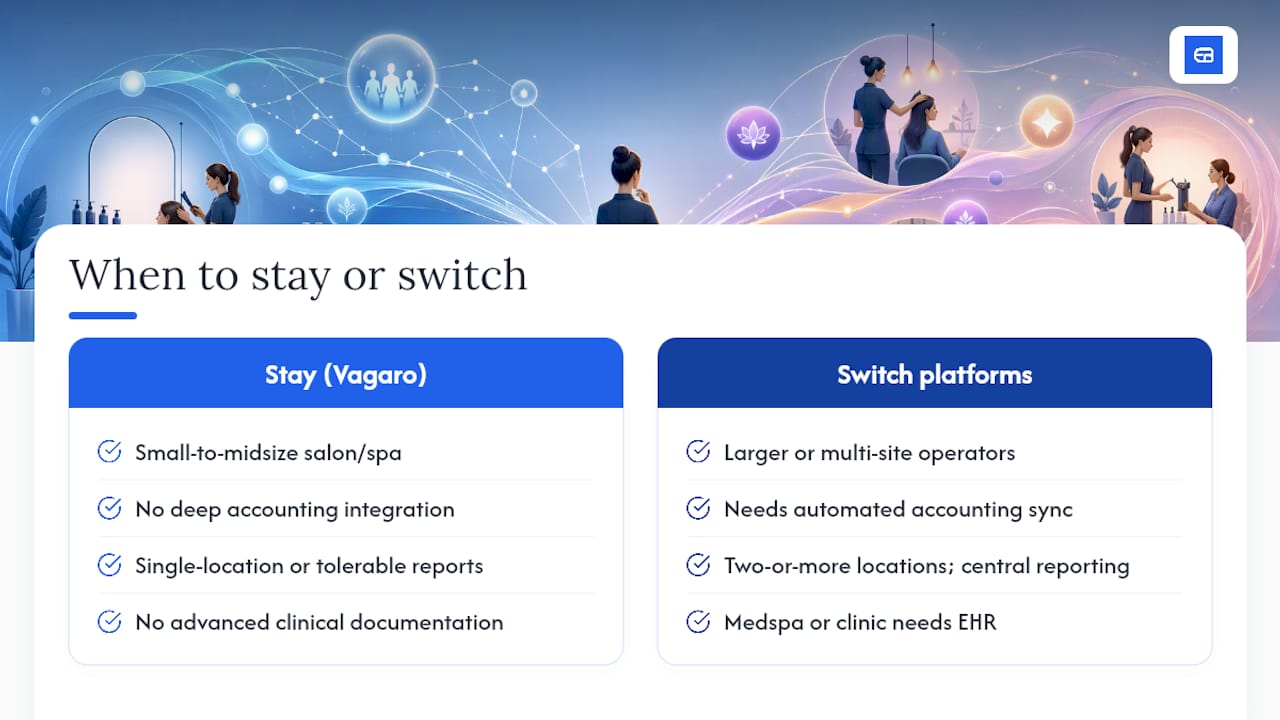
The honest answer is that Vagaro works well for a specific operator profile: a small-to-midsize salon or spa that values marketplace exposure, doesn’t need deep accounting integration, and is comfortable with its pricing structure. If that describes your business, switching carries real migration costs for limited gain.
The case for switching becomes clear when one or more of these conditions apply. If your accountant spends hours each month reconciling Vagaro’s payment exports with QuickBooks or Xero, an automated sync like Expressbook’s eliminates that entirely. If you’re running two or more locations and finding Vagaro’s reporting too fragmented, a platform built for multi-site management will pay for itself in staff time. If you’re a medspa or clinical practice that has outgrown Vagaro’s documentation tools, a platform with native EHR features is a compliance necessity, not a preference.
Before committing to any switch, test two things in every demo: data export (can you get everything out cleanly?) and the client booking flow on mobile (does it work without a required account?). Those two factors determine whether a migration is worth the disruption.
Contract length is the most overlooked cost. Some platforms lock operators into annual or multi-year agreements with steep cancellation fees. Verify the exit terms before signing, and treat any vendor that won’t disclose them during a demo as a red flag.
The best alternative is the one that fits your operational model. Solo professionals need simplicity and predictable pricing. Multi-location groups need centralized reporting and staff controls. Class-heavy studios need membership and pack management. Medspas need clinical compliance. Matching the platform to the model, rather than chasing the lowest headline price, is what makes a migration worth the effort.
Expressbook is the recommended alternative for most operators who need integrated accounting sync and accessible booking; however, depending on your business model, platforms like Mindbody (for class-based studios), Portrait Care (for medspas/clinical compliance), or Square Appointments, GlossGenius, or Goldie (for solo pros) may be a better match.
If you’ve been running the numbers on Vagaro alternatives, Expressbook addresses the two friction points that come up most often: accounting reconciliation and accessible booking. Its automated sync with QuickBooks and Xero means bookings, payments, and client data post to your accounting software without manual exports. The voice agent lets visually impaired clients book appointments and ask questions about your business independently, a feature no other platform in this list offers natively.
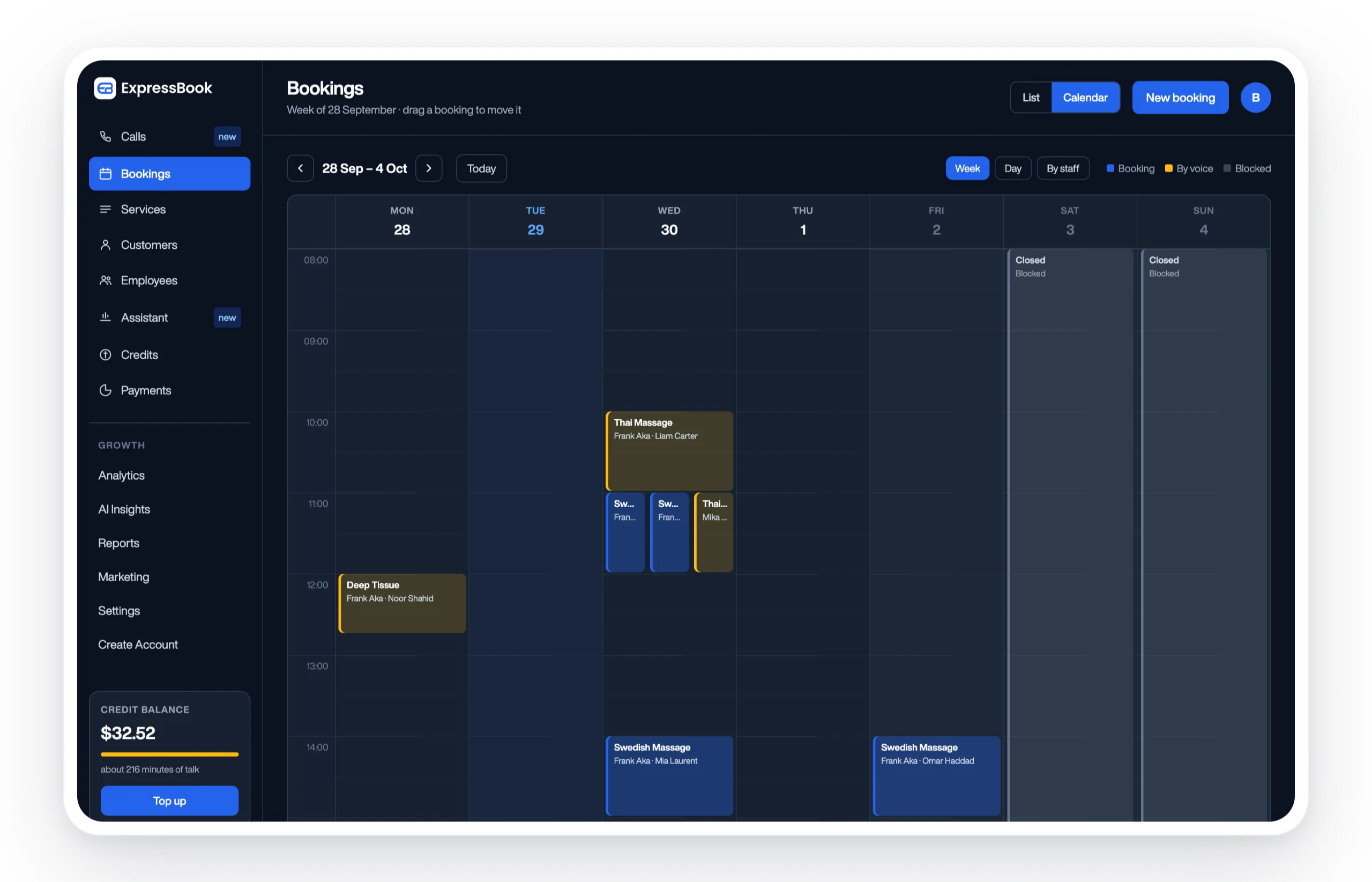
The platform covers appointment scheduling, POS and payments, memberships, multi-location support, branded booking pages, automated reminders, AI-powered analytics, and a dedicated mobile app for both admins and clients. For operators evaluating spa and salon management software or medspa-specific scheduling, Expressbook’s vertical depth matches what most small-to-midsize operators actually need.
There is no subscription, so a small credit top-up is enough to run a real parallel test alongside your current platform. Set up your account at Expressbook and use the first two weeks to test the accounting sync, the mobile admin app, and the client booking flow end-to-end.
Sources
When researching platforms, cross-reference at least two independent review sources before making a decision. Lifetime average ratings can mask recent support or product quality changes — filter for reviews from the past 12 months and check whether the vendor responds to critical feedback.
- Thesalonbusiness
- Vagaro Review (2026) – MakerStack
- Top Vagaro Alternatives, Competitors
- Capterra
- Boulevard reviews on G2
- AMTA
How to read reviews effectively: Look for patterns across multiple reviewers rather than individual outliers. Pay attention to how recently reviews were posted, whether the vendor replies to complaints, and whether negative reviews cluster around a specific feature (support, billing, mobile app). A platform with a strong lifetime rating but no recent reviews may have stagnated in development.