

What are the best Fresha alternatives for salon and spa booking software?
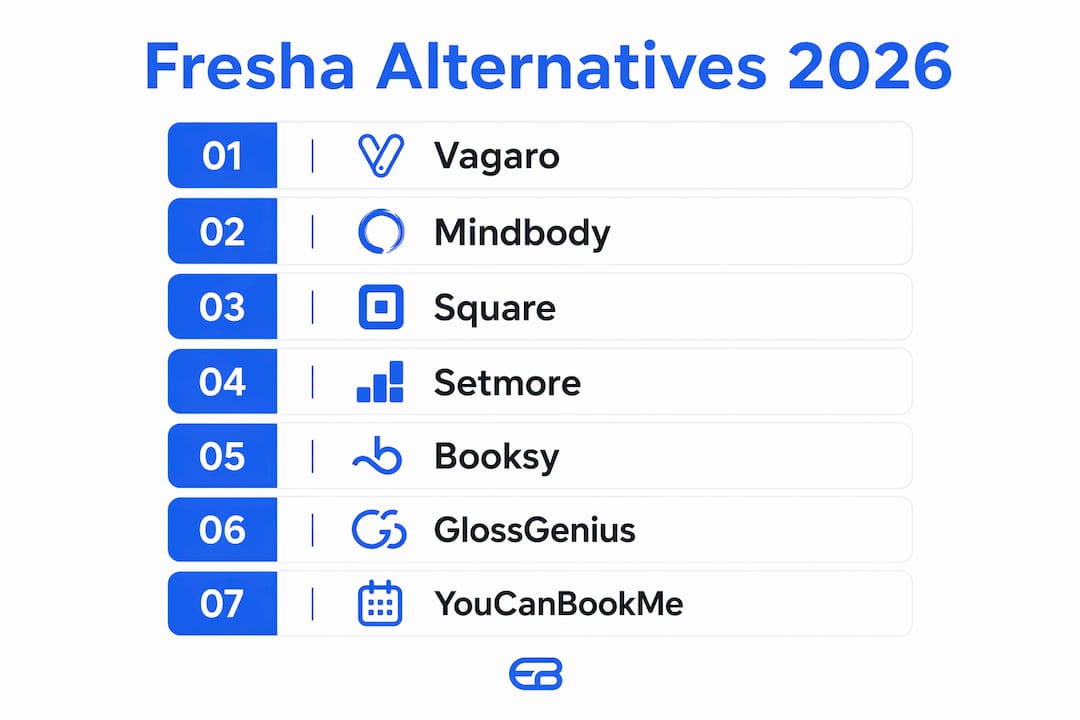
The strongest Fresha alternatives in 2026 are Vagaro, Mindbody, Square Appointments, Setmore, Booksy, GlossGenius, YouCanBookMe, EnvisionNow, and Lunacal. Each solves a different problem: Vagaro suits scaling salons that want flat fees and built-in marketing; Square Appointments is the go-to for teams that need a free plan with unlimited staff calendars; GlossGenius wins for independent stylists who care about branding. Fresha’s shift to a per-staff calendar fee has pushed many salon owners to recalculate their total costs, and the alternatives below give you a clear path forward.
The table below maps each platform against the dimensions that matter most for salon and spa operations.
| Platform | Best For | Key Features | Pricing Model | Marketplace Presence | Customer Support |
|---|---|---|---|---|---|
| Vagaro | Scaling salons | POS, loyalty, marketing automation | Flat monthly fee | Yes, active marketplace | Phone, chat, email |
| Mindbody | Wellness spas, multi-location | Scheduling, marketing, integrations | Tiered subscription | Strong marketplace | Phone, chat, email |
| Square Appointments | Small to mid-sized salons | POS integration, unlimited staff | Free plan + paid tiers | No marketplace | Chat, email |
| Setmore | Solo pros, small salons | Basic scheduling, video booking | Generous free plan | No marketplace | Chat, email |
| Booksy | Client acquisition focused | Marketplace, reviews, scheduling | Monthly subscription | Extensive marketplace | Chat, email |
| GlossGenius | Independent professionals | Branded pages, zero commissions | Flat monthly fee | No marketplace | Chat, email |
| YouCanBookMe | Small salons, spas | Custom booking pages, integrations | Free plan + paid tiers | No marketplace | Email, help center |
| EnvisionNow | Tech-savvy salons | Comprehensive management tools | Subscription | No marketplace | Phone, chat |
| Lunacal | Complex scheduling needs | Adaptable appointment types | Tiered plans | No marketplace | Chat, email |
Quick orientation by business size:
- Solo professionals: GlossGenius, Setmore, YouCanBookMe
- Small to mid-sized salons: Square Appointments, Vagaro, Booksy
- Larger or multi-location businesses: Mindbody, Vagaro, EnvisionNow
- Tech-forward or niche operations: Lunacal, EnvisionNow, Expressbook
How do Fresha alternatives compare on features, pricing, and business fit?
Choosing between these platforms comes down to three variables: what you pay per month, what you pay per transaction, and whether the platform actively sends you new clients or expects you to bring your own. Most salon owners underestimate the second and third variables when they compare sticker prices.
Fresha’s per-staff calendar charge illustrates the point. The per-staff pricing model results in higher annual costs as you hire more staff compared to flat-fee alternatives. That gap widens as you hire. Vagaro’s flat monthly fee, by contrast, covers the whole team regardless of headcount, and it bundles POS, loyalty programs, and marketing automation in the same plan.
Marketplace presence splits the field in two. Booksy and Mindbody run active consumer marketplaces that surface your salon to people who have never heard of you. That is valuable for new businesses or those in competitive markets. Square Appointments, GlossGenius, and YouCanBookMe have no marketplace at all, which means you own your client relationships completely but must drive your own traffic.
Payment processing costs are the most commonly overlooked line item. Platforms that charge a percentage on every booking add up fast for high-volume salons. GlossGenius charges zero commissions on bookings, and Square Appointments passes through Square’s standard card processing rate with no booking markup. Mindbody’s higher-tier plans include more features but also carry higher monthly fees, so the math only works if you use the full feature set.
Feature and pricing snapshot:
| Platform | Starting Price | Per-Staff Fee | Commission on Bookings | Multi-Location |
|---|---|---|---|---|
| Vagaro | Paid flat monthly | No | No | Yes |
| Mindbody | Tiered subscription | No | No | Yes |
| Square Appointments | Free plan available | No | No | Yes |
| Setmore | Free plan available | No | No | Limited |
| Booksy | Monthly subscription | No | No | Limited |
| GlossGenius | Flat monthly fee | No | No | No |
| YouCanBookMe | Free plan available | No | No | No |
| EnvisionNow | Subscription | No | No | Yes |
| Lunacal | Tiered plans | No | No | Limited |
User experience quality varies more than most comparison articles admit. Setmore and Square Appointments consistently earn praise for clean, intuitive interfaces that require almost no training. Mindbody is powerful but has a steeper learning curve, which matters if your front desk staff turns over frequently. GlossGenius prioritizes aesthetics: its booking pages look polished out of the box, which directly affects how clients perceive your brand before they even walk through the door.
Customer support quality is another differentiator that only shows up when something goes wrong. Vagaro offers phone support, which is rare in this category. Most competitors rely on chat and email, with response times that vary by plan tier.
In-depth reviews of each Fresha alternative
Vagaro
Vagaro targets salons that have outgrown basic scheduling tools and need a full hairdressers and beauty salons marketing technology solution business management suite. The platform combines appointment scheduling, a built-in POS system, payroll processing, email and SMS marketing, and a loyalty program under one flat monthly fee. That fee covers unlimited staff, which is the direct answer to Fresha’s per-seat pricing.

The Vagaro marketplace is active and gives your salon visibility to clients searching for services in your area. Vagaro also offers a custom branded mobile app as an add-on, letting established salons present a professional, branded booking experience to returning clients. The marketing automation tools, including automated follow-up campaigns and review requests, are genuinely useful for salons that want to grow without hiring a marketing coordinator.
Pros: Flat fee covers all staff; strong POS and loyalty tools; active marketplace; phone support available.
Cons: Monthly cost is higher than entry-level alternatives; some advanced features require add-on purchases.
Mindbody
Mindbody is the dominant platform in the wellness space, used by spas, yoga studios, gyms, and med spas that need more than basic appointment booking. Its marketplace, the Mindbody app, has a large consumer base actively searching for wellness services, which gives listed businesses a real acquisition channel.

The platform’s feature set covers scheduling, staff management, marketing campaigns, membership billing, and integrations with tools like ClassPass. For multi-location businesses, Mindbody’s reporting and centralized management tools are genuinely useful. The tradeoff is cost: Mindbody’s tiered plans sit at the higher end of the market, and the full feature set requires a higher-tier subscription. Businesses that only need basic scheduling will find they are paying for capabilities they never use.
Pros: Large consumer marketplace; strong multi-location support; broad integrations; wellness-specific features.
Cons: Higher price point; steeper learning curve; overkill for solo professionals or small salons.
Square Appointments
Square Appointments earns its place on this list by solving one specific problem exceptionally well: it gives small and mid-sized salons a free plan with unlimited staff calendars and no per-booking commissions. The integration with Square’s POS system means payments, tips, and refunds all flow through one system without manual reconciliation.
For salons already using Square for card payments, adding Square Appointments costs nothing at the entry level. Paid plans unlock additional features like SMS reminders and more advanced reporting. The platform has no marketplace, so client acquisition depends entirely on your own marketing. That is a reasonable tradeoff for established salons with a loyal client base that simply want a clean, reliable booking system.
Pros: Free plan with unlimited staff; no commissions; tight POS integration; easy setup.
Cons: No marketplace for new client discovery; limited advanced features on free plan.
Setmore
Setmore is the right choice for solo stylists and small teams that need a booking page up and running in under an hour. Its free plan is genuinely functional, covering basic appointment scheduling, email reminders, and a public booking page. Paid plans add SMS reminders, two-way calendar sync, and payment processing.
The interface is clean and requires no technical knowledge to configure. Setmore also supports video booking through Teleport and Zoom integrations, which is useful for consultations. It lacks the marketing depth of Vagaro or the marketplace reach of Booksy, but for a solo professional who just needs clients to book online without paying a monthly fee, Setmore delivers exactly that.
Pros: Generous free plan; fast setup; video booking support; easy interface.
Cons: Limited marketing tools; no marketplace; not suited for larger teams or complex workflows.
Booksy
Booksy is built around client acquisition. Its marketplace connects salons with clients who are actively searching for services nearby, and the platform’s review system helps new businesses build credibility quickly. For a salon opening in a competitive market, that built-in discovery channel is worth real money.
The Booksy platform covers scheduling, automated reminders, client management, and payment processing. Its monthly subscription fee is straightforward, with no commission on bookings made through the marketplace. The tradeoff is that Booksy’s non-marketplace features are less deep than Vagaro’s or Mindbody’s, so salons that need advanced marketing automation or loyalty programs may find it limiting over time.
Pros: Strong marketplace for new client discovery; review system builds credibility; no booking commissions.
Cons: Fewer advanced management features; less suited for businesses that already have a full client base.
GlossGenius
GlossGenius is purpose-built for independent beauty professionals who want their booking experience to look as polished as their work. The platform generates custom branded booking pages with no design skill required, charges zero commissions on bookings, and keeps its monthly fee flat regardless of booking volume.
Beyond aesthetics, GlossGenius handles payments, automated reminders, client notes, and basic reporting. It does not have a marketplace, and it is not designed for multi-location businesses or large teams. For a solo stylist or esthetician who wants a premium client experience without paying a developer, GlossGenius is the most direct path to that outcome.
Pros: Beautiful branded booking pages; zero commissions; flat monthly fee; easy for solo professionals.
Cons: No marketplace; limited team management features; not suited for growing multi-staff salons.
YouCanBookMe
YouCanBookMe gives small salons and spas a flexible booking page that connects directly to Google Calendar or Outlook. Setup is fast, and the customization options let you control availability windows, buffer times, and booking form fields without any technical configuration.
The free plan covers basic scheduling for one calendar. Paid plans unlock multiple team members, custom branding, and more advanced automation. YouCanBookMe has no marketplace and no POS integration, so it works best as a scheduling layer on top of existing tools rather than an all-in-one solution. For a small spa that already manages payments separately and just needs a clean online booking page, it fits that gap well.
Pros: Fast setup; flexible calendar integrations; customizable booking pages; free plan available.
Cons: No marketplace; no POS; limited as a standalone salon management tool.
EnvisionNow
EnvisionNow targets tech-forward salons that want comprehensive management features beyond basic scheduling. The platform covers appointment booking, staff management, inventory tracking, client history, and reporting in a single system. Its interface is designed for salons that run complex operations with multiple service providers and treatment rooms.
EnvisionNow supports multi-location management, which makes it a viable option for salon groups or franchises that need centralized oversight. It does not have a consumer marketplace, so new client acquisition depends on your own channels. The platform suits businesses that have already built their client base and need better operational control rather than a discovery tool.
Pros: Comprehensive management features; multi-location support; strong reporting; inventory tracking.
Cons: No marketplace; higher complexity than simpler alternatives; may be more than solo professionals need.
Lunacal
Lunacal is designed for businesses with scheduling complexity that standard booking tools handle poorly. Its appointment types are highly configurable, supporting variable durations, resource assignments, and multi-step booking flows that work for spas offering packages or salons with shared equipment.
The Lunacal platform offers tiered plans with increasing levels of customization and team management. It does not have a marketplace, and its feature set is focused on scheduling precision rather than marketing or POS. For a spa that offers multi-service packages with specific room and equipment requirements, Lunacal handles that complexity more cleanly than most general booking tools.
Pros: Highly configurable appointment types; resource management; adaptable to complex workflows.
Cons: No marketplace; limited marketing features; smaller user community than established platforms.
Why salon and spa businesses switch from Fresha, and how to choose the right alternative
The most common trigger for switching is pricing. Fresha’s per-staff calendar fee changes the cost calculation for any salon with more than two or three team members. Per-staff calendar fees can significantly increase annual costs for salons as staff count grows compared to flat-fee models. That number is concrete and easy to model, which is why it drives so many owners to start evaluating alternatives.
Beyond pricing, the second most common reason is branding control. Fresha’s marketplace puts your salon alongside competitors, and the booking experience carries Fresha’s branding rather than yours. Platforms like GlossGenius and Vagaro let you present a fully branded experience, which matters for salons that have invested in building a distinct identity.
Feature gaps are the third driver. Fresha covers the basics well, but salons that need advanced loyalty programs, payroll integration, or detailed marketing automation often find they need a platform built for those use cases specifically.
Common reasons businesses switch from Fresha:
- Per-staff pricing that scales costs faster than revenue
- Limited branding control on the booking page and client communications
- Lack of advanced marketing automation or loyalty tools
- No built-in POS for in-person payment management
- Marketplace dependency that reduces direct client relationships
Total cost of ownership: what to calculate before you switch
The sticker price of any booking platform is rarely the full cost. Hidden fees like payment processing markups, per-seat charges, and add-on costs for features like SMS reminders or advanced reporting can push the real monthly cost well above the advertised rate. Before committing to any alternative, calculate the full cost at your current staff size and booking volume.
Payment processing is the most frequently overlooked variable. A platform that charges 2.9% plus $0.30 per transaction costs a high-volume salon far more than one with a flat monthly fee and standard card rates. Run the numbers at your actual monthly booking revenue, not a hypothetical.
Migration pitfalls to avoid
Switching platforms is not just a pricing decision. Your client history, appointment records, and staff notes all need to move with you. Testing a sample import of 5–10 client records before committing to a full migration is the single most effective way to catch data integrity problems before they affect real clients.
Most platforms offer a data import tool, but the quality varies significantly. Some preserve appointment history; others only import contact details. Ask the vendor explicitly what data transfers and in what format before you sign up.
Pro Tip: Run a parallel period of two to four weeks where both systems are active before fully cutting over. This gives your team time to learn the new interface without risking missed appointments or lost client data.
Which platforms suit larger or niche service businesses?
General booking software covers most salon and spa needs, but some businesses require capabilities that the mainstream platforms do not offer. Medical spas, franchise groups, and high-volume multi-location operations often need compliance features, advanced automation, and centralized reporting that tools like Setmore or YouCanBookMe simply were not built to provide.
Two platforms worth knowing in this tier are Mangomint and Boulevard. Boulevard’s pricing starts at approximately $176 per location as of mid-2026, positioning it firmly in the premium market. It is designed for upscale salons and med spas that need precise client journey management, automated intake forms, and compliance-ready documentation. The interface is polished and the onboarding is structured, which reflects its target market.
Mangomint targets high-volume salons and spas that want to automate as much of the front desk as possible. Its automation tools handle appointment confirmations, waitlist management, and client follow-ups without manual intervention. For a busy salon processing dozens of bookings daily, that automation reduces front desk labor costs in a measurable way.
Who benefits most from specialized platforms:
- Medical spas needing intake forms, consent documentation, and HIPAA-aware workflows
- Franchise groups requiring centralized reporting across multiple locations
- High-volume salons where front desk automation directly reduces staffing costs
- Businesses with complex service menus that require resource and room assignment
The adoption of AI-powered scheduling assistants is accelerating in this segment. Platforms that automate routine admin tasks free staff to focus on the client experience rather than managing a booking queue. For salons competing at the premium end of the market, that operational efficiency is a genuine differentiator.
What makes Expressbook a strong alternative for service businesses?
Expressbook is built for service businesses that need their booking system to connect directly to their accounting software. Its automatic sync with QuickBooks and Xero eliminates the manual data entry that consumes hours at the end of every month. According to Expressbook’s platform overview, the system saves users over 10 hours per week by automating booking confirmations, payment reconciliation, and client data updates across connected tools.
The platform covers the full operational stack: real-time availability management, AI-powered analytics, automated reminders, branded booking pages, payment and refund handling, and Google Calendar integration. For salons and spas that currently manage bookings in one system and accounting in another, Expressbook removes the gap between those two workflows entirely.
Key Expressbook capabilities:
- Automatic sync with QuickBooks and Xero, eliminating manual accounting entries
- AI-powered analytics that surface booking trends and revenue patterns
- Real-time availability management to prevent double-bookings
- Automated reminders that reduce no-shows without manual follow-up
- Branded booking pages that present your business identity to clients
- Google Calendar integration for staff scheduling visibility
- Dedicated mobile app for both clients and admins
- Voice agent support, allowing visually impaired clients to book appointments and get answers to business questions
- No subscription: prepaid credits drawn down by the second of talk time
The voice agent feature is genuinely uncommon in this category. Most booking platforms assume all clients interact through a screen. Expressbook’s voice agent makes the booking process accessible to visually impaired clients, which expands your potential client base and reflects a more inclusive approach to service delivery.
For salons and spas that want salon booking software that handles both the client-facing booking experience and the back-office accounting connection, Expressbook addresses both without requiring separate tools or manual data transfers.
How to choose the best Fresha alternative for your salon or spa
Start with your staff count and booking volume, because those two numbers determine which pricing models actually work in your favor. A solo stylist has different math than a ten-chair salon. Flat-fee platforms like Vagaro favor larger teams; free-tier platforms like Square Appointments or Setmore favor smaller operations that want to keep fixed costs low.
Essential criteria for evaluating any booking platform:
- Pricing transparency: Can you calculate the full monthly cost including payment processing, SMS fees, and any per-feature charges before you sign up?
- Feature fit: Does the platform cover your actual workflow, including POS, staff scheduling, client notes, and marketing, or will you need separate tools for some of those?
- Marketplace vs. independent: Do you want the platform to send you new clients, or do you prefer to own your client relationships directly?
- Integration depth: Does it connect to the tools you already use, such as accounting software, email marketing platforms, or your existing calendar?
- Support quality: Is phone support available, or are you limited to chat and email? How fast does the vendor respond when something breaks?
- Migration support: Will the vendor help you import your existing client data, and what format does it accept?
Questions to ask any vendor before purchasing:
- What data can I import from my current platform, and in what format?
- Are there fees beyond the monthly subscription, including payment processing, SMS, or add-on features?
- What happens to my data if I cancel?
- Does the platform have a marketplace, and if so, does it charge a commission on marketplace bookings?
- What support channels are available on my plan, and what are the response time commitments?
Marketplace presence deserves its own evaluation. If your salon is established with a loyal client base, paying for a marketplace you do not need adds cost without benefit. If you are opening a new location or entering a competitive market, a platform with an active consumer marketplace can accelerate client acquisition in a way that organic marketing alone cannot match.
Pro Tip: Before migrating, export your full client list and appointment history from Fresha in CSV format. Then run a test import of ten records into your chosen alternative to verify that names, contact details, appointment dates, and notes all transfer correctly. Fix any mapping errors at the sample stage, not after a full migration.
Evaluating scheduling software for small businesses means looking past the feature list and into the actual cost structure. Two platforms with identical feature sets can have very different total costs depending on your booking volume, staff size, and payment processing needs. Build a simple spreadsheet with your actual numbers before making a final decision.
For salons considering multi-location expansion, the platform choice today affects your options tomorrow. Platforms like Mindbody, Vagaro, and EnvisionNow support multi-location management natively. Switching platforms after you open a second location is significantly more disruptive than choosing a scalable option from the start. If growth is part of your plan, factor that into the evaluation now rather than after the fact.
How these platforms were evaluated
Every platform in this comparison was assessed against the same set of criteria: feature depth, pricing transparency, ease of use, marketplace presence, customer support quality, and suitability for different business sizes. The evaluation drew on published platform documentation, user reviews from G2 and Trustpilot, and publicly available pricing pages as of mid-2026.
Pricing information reflects each platform’s published rates at the time of writing. Subscription costs, plan tiers, and included features change, so verifying current pricing directly with each vendor before purchasing is advisable.
User experience assessments reflect the interface complexity and onboarding requirements that appear consistently across independent user reviews. No single review source was treated as definitive. Patterns across multiple review platforms carried more weight than individual opinions.
Marketplace presence was evaluated on whether the platform operates a consumer-facing directory that actively surfaces listed businesses to new clients, not simply whether the platform has a public booking page. The distinction matters for salons that rely on the platform for client acquisition versus those that manage their own marketing.
Customer support quality was assessed based on the channels available (phone, chat, email), the plan tiers that include each channel, and the consistency of support quality reported in user reviews. Phone support availability was weighted as a differentiator because it is genuinely rare in this product category.
Expressbook gives you a different path to managing your bookings
If you have been comparing Fresha alternatives and keep running into the same tradeoffs, Expressbook offers a route worth considering. The platforms reviewed above each solve specific problems well. Expressbook solves a different one: the gap between your booking system and your accounting software.
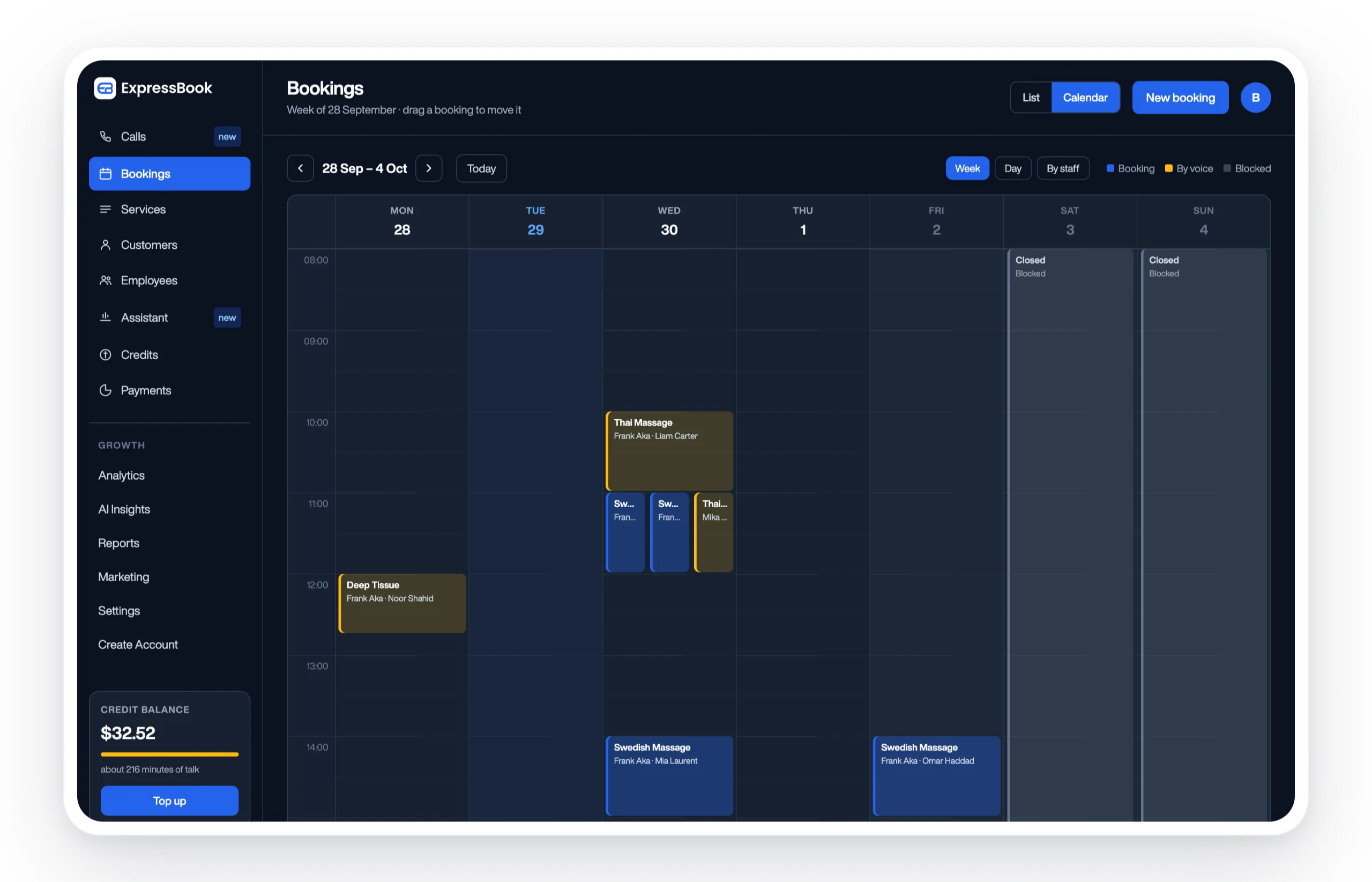
Expressbook automatically syncs bookings, payments, and client data with QuickBooks and Xero, which means your end-of-month reconciliation happens in the background rather than consuming hours of manual work. The platform includes AI-powered analytics, real-time availability management, automated reminders, branded booking pages, and a dedicated mobile app for both clients and admins. Its voice agent makes booking accessible to visually impaired clients, a feature that most booking platforms have not addressed at all.
For salons and spas ready to test a platform that connects scheduling directly to accounting, Expressbook has no subscription: a small credit top-up lets you evaluate the full feature set, including the QuickBooks and Xero sync. If you want to see how it compares to one of the most popular alternatives in this space, the Expressbook vs Square Appointments breakdown covers the key differences in detail. The Expressbook platform is built for service businesses that want fewer tools doing more work, not more tools creating more complexity.
Key Takeaways
The right Fresha alternative depends on your staff size, pricing model preference, and whether you need a marketplace to attract new clients or prefer to own your client relationships directly.
| Point | Details |
|---|---|
| Per-staff pricing drives switching | Five staff members cost about $600 more per year under Fresha’s per-seat model compared to a flat-fee alternative, based on the current per-staff calendar fee. |
| Marketplace vs. independence | Booksy and Mindbody send you new clients; Square Appointments and GlossGenius give you full ownership of client relationships. |
| Hidden fees change the math | Payment processing markups, SMS charges, and add-on fees often push real monthly costs well above the advertised subscription price. |
| Test migration before committing | Import 5–10 sample client records into any new platform to verify that appointment history and client notes transfer correctly. |
| Expressbook for accounting integration | Expressbook syncs bookings and payments with QuickBooks and Xero automatically, saving over 10 hours per week in admin work, running on prepaid credits with no monthly fee. |