Set a 24 to 48 hour cancellation window, charge fees proportional to your actual loss, and commit to processing eligible refunds within five business days. That’s the baseline. Fees should recover reserved-time costs, not punish clients.
Three moves to make today:
- Publish the policy text on your booking page, not buried in a PDF.
- Add a click-to-accept checkbox at checkout so clients confirm they read it.
- Configure your booking system to collect deposits or auto-apply cancellation fees.
Key Takeaways
A defensible refund policy for services pairs a proportional fee structure with a five-business-day processing commitment, published visibly and enforced through automation rather than staff judgment calls.
| Point | Details |
|---|---|
| Set proportional fees | Base cancellation and no-show fees on actual lost revenue, never a flat penalty rate. |
| Commit to a processing window | Process eligible refunds within five business days and warn clients about bank posting delays. |
| Publish policy everywhere | Show terms on the booking page, confirmation email, reminders, and staff scripts. |
| Prorate partial refunds by units | Refund unused sessions in a package rather than guessing at a percentage. |
| Automate enforcement with ExpressBook | ExpressBook auto-applies fees, triggers refunds, and syncs everything to QuickBooks or Xero. |
Table of Contents
- Building a Refund Policy for Services That Actually Holds Up
- How Do You Set Fees That Won’t Get Challenged as Penalties?
- What Happens After You Approve a Refund?
- Automating Enforcement So Nobody Has to Play Bad Cop
- Where Should Your Cancellation Policy Actually Live?
- Copy-Ready Wording for Your Booking Page and Contracts
- When Does a Client Actually Qualify for a Refund?
- How Should You Handle a Refund Dispute?
- What Happens When You Cancel, Not the Client?
- How Do You Refund a Service That’s Already Partly Done?
- Let ExpressBook Enforce the Policy So You Don’t Have To
- Sources
Building a Refund Policy for Services That Actually Holds Up
A refund policy for services only works if every clause is specific enough to enforce without a debate. Vague language (“cancellations may incur a fee”) invites arguments. Precise language (“cancellations made less than 24 hours before the appointment incur a $25 fee”) ends them before they start.
Start with definitions. A cancellation is the client withdrawing before the appointment; a reschedule moves the appointment to a new time without forfeiting payment; a no-show means the client never showed up or canceled. Notice is “received” only when it arrives through your named channel, whether that’s a booking portal, email, or phone call, not a text to a stylist’s personal number.
- Cancellation window. Common ranges run 24, 48, or 72 hours depending on how hard the slot is to refill, according to LegalClarity’s guidance on cancellation wording. A 90-minute massage slot in a small studio often needs 48 hours; a group fitness class might only need 24.
- Deposit terms. State the exact dollar amount or percentage, what it covers (holding the slot), and whether it’s refundable outside the cancellation window.
- Late-cancellation and no-show fees. Spell out the amount or percentage and the trigger. Example: “No-shows are charged 100% of the service price; cancellations inside the notice window are charged 50%.”
- Credits versus cash refunds. Decide which situations earn a credit toward future services versus a cash refund, and state an expiration date on credits (commonly 6 to 12 months).
Pro Tip: Frame every fee as recovering the cost of a reserved slot your staff couldn’t fill, never as a penalty for canceling. That single wording shift makes the clause easier to enforce and less likely to trigger a chargeback dispute.
How Do You Set Fees That Won’t Get Challenged as Penalties?
The legal test is simple: a cancellation fee should approximate your actual loss or cost, not exceed it. Charge a full session price for a 10-minute-late cancellation and you’re inviting a challenge. Guidance on unfair contract terms and proportionality is consistent on this point: fees written as punishment for breach, rather than compensation for loss, risk being struck down as unenforceable.
Three fee models cover most service businesses:
- Flat fee works when your loss is predictable, like a $50 no-show fee for a fixed-length haircut.
- Percentage fee fits variable-cost services, such as 50% of a therapy session’s rate for late cancellations.
- Sliding scale rewards earlier notice, like a full refund at 72+ hours, 50% at 24 to 71 hours, and 0% inside 24 hours.
A salon’s one-hour slot typically justifies a $20 to $40 fee. A group fitness class, where one absence rarely leaves an empty room, usually justifies no fee at all beyond a deposit forfeiture.
Document your reasoning: note the average revenue lost per missed slot and how difficult that slot is to refill. That paper trail is your defense if a client disputes the charge.
What Happens After You Approve a Refund?
Commit publicly to processing eligible refunds within five business days of confirmed cancellation. That’s the standard window payment processors cite, though the credit itself can take another few business days to post depending on the client’s bank.
Two sentences worth stealing for your own policy:
- “Eligible refunds are processed within a few business days of the cancellation being confirmed.”
- “Refunds are issued to the original payment method; your bank may take additional time to post the credit.”
When a client asks why their refund hasn’t landed yet, the honest answer is usually: we processed it on our end, but your bank hasn’t posted it. Saying that plainly, with the date you processed it, resolves most of these conversations without escalation.
For bookkeeping, log every refund, credit, and retained deposit the day it happens, not at month-end. A retained no-show fee is revenue; a refund is a reversal; a credit is a liability until redeemed. Mixing those categories is one of the most common reconciliation headaches for appointment-based businesses.
Automating Enforcement So Nobody Has to Play Bad Cop
Manual enforcement means a staff member has to decide, on the spot, whether to charge a client’s card, and that’s an awkward conversation nobody wants to have twice a day. Automating the rule removes the judgment call.
- Require acknowledgment at booking. A checkbox confirming the client read the cancellation policy before payment.
- Collect deposits automatically for services with high no-show rates or high material costs.
- Auto-apply fees the moment a cancellation falls inside your notice window, no manual override needed.
- Trigger refund or credit flows automatically once a cancellation qualifies, rather than waiting for someone to remember.
- Log every action (timestamp, amount, reason) so you have evidence if a dispute arises later.
Automated reminders sent 24 to 48 hours before an appointment cut down on late cancellations before they happen. Pair that with a confirmation message, a cancellation acknowledgment, and a refund receipt, and clients always know exactly where things stand.
Syncing fees and refunds directly into QuickBooks or Xero removes the manual entry step that causes most end-of-month reconciliation errors. Run a test cancellation and a test refund through your system monthly, then check that the transaction landed correctly in your books.
Pro Tip: Test your automation with a $1 dummy booking every quarter. It’s the fastest way to catch a broken refund trigger before a real client hits it.
Where Should Your Cancellation Policy Actually Live?
Visibility is what makes a policy enforceable. A rule buried in a terms page nobody reads won’t hold up in a dispute the way one shown at three separate touchpoints will, a point echoed in guidance on creating cancellation policies for service businesses.
- Booking page: the policy text sits above or beside the “confirm booking” button.
- Confirmation email: restate the cancellation window and fee amount.
- Reminder messages: a one-line recap 24 to 48 hours out.
- Staff scripts: front-desk and phone staff should quote the same wording, word for word.
Capture acceptance with a click-to-accept checkbox or a signed intake form. That record is what turns “we told them” into proof. For enforcement, reserve exceptions for genuine emergencies, offer a reschedule before a refund when it fits the situation, and issue a credit instead of a cash refund for loyal clients you want to retain.
Copy-Ready Wording for Your Booking Page and Contracts
Paste and adjust these to match your own numbers:
- “Cancellations made more than 48 hours before your appointment receive a full refund.”
- “Cancellations made 24 to 48 hours before your appointment are charged 50% of the service price.”
- “A $30 deposit is required to book; this deposit is non-refundable for cancellations inside 24 hours.”
- “No-shows are charged the full service price and forfeit any deposit paid.”
- “Eligible refunds will be processed within a few business days of confirmed cancellation, to your original payment method.”
| Snippet | Best used for |
|---|---|
| Tiered notice window | Salons, spas, tattoo studios |
| Flat no-show fee | Single-provider appointments (therapists, consultants) |
| Non-refundable deposit | High-demand or bespoke bookings |
| Five-day processing line | Any business taking online payments |
When Does a Client Actually Qualify for a Refund?
Not every complaint should trigger a refund, and treating every dissatisfied client the same way trains people to complain for money back. Set clear eligibility categories instead of deciding case by case.
Legitimate refund triggers usually fall into three buckets: the service wasn’t delivered as described (a haircut that ignored explicit instructions), a safety or hygiene failure occurred, or the provider canceled and no reschedule worked for the client. Vague dissatisfaction (“I just didn’t love it”) is harder to standardize, but a reasonable middle ground is offering a complimentary correction visit before a cash refund. That protects your margin while still addressing the complaint.
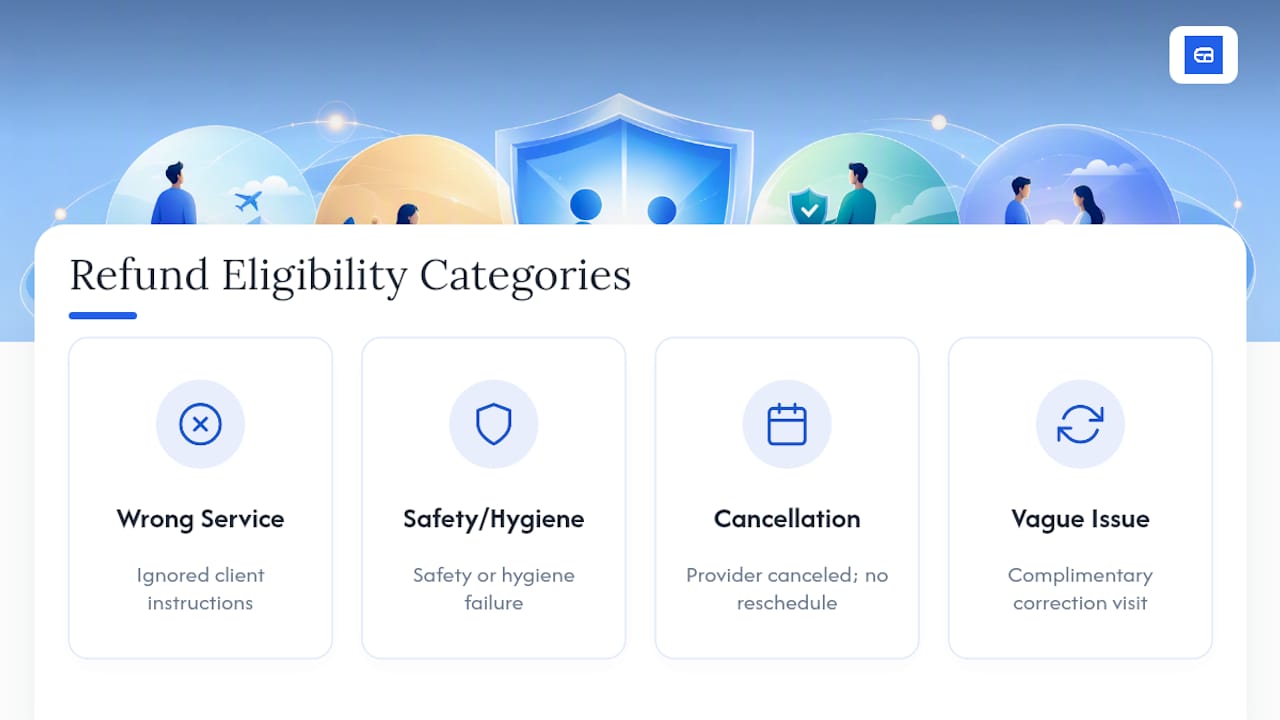
Document a dissatisfaction threshold in your staff training: minor preference issues get a follow-up conversation and possibly a discount on the next visit; documented service failures get a partial or full refund. Put this in writing internally, even if it doesn’t appear word-for-word on your public policy page, so every staff member applies the same standard.
Time matters too. A client who complains within 24 to 48 hours of the service has a stronger claim than one who waits three weeks. State a complaint window in your policy (commonly 7 days) so refund eligibility doesn’t stay open indefinitely.
How Should You Handle a Refund Dispute?
Most disputes start small and escalate only when the client feels unheard. A structured process keeps a $40 disagreement from turning into a credit card chargeback that costs you more in fees than the original service.
Start with a first-response window: acknowledge any refund request within one business day, even if the answer is “we’re reviewing this.” Silence is what pushes clients to dispute the charge with their bank instead of working it out with you directly.
Escalate through three tiers. Front-line staff handle standard cases using your documented eligibility criteria. A manager reviews anything involving a safety complaint, a repeat client, or an amount above a set threshold. Owner-level review applies only to disputes that staff and managers can’t resolve, or that involve a chargeback already filed with the bank.
Keep a paper trail for every dispute: the original booking record, the cancellation or service notes, and the resolution offered. That record is what wins a chargeback dispute with your payment processor if it comes to that. The risk of vague or automated responses creating liability is real; one airline was held liable after its support chatbot invented a refund policy that didn’t match the company’s actual terms. Whatever automated messages your booking system sends, make sure the wording matches your published policy exactly.
What Happens When You Cancel, Not the Client?
A refund policy for services has to cover cancellations you initiate, not just the client’s. This is the clause most business owners forget to write, and it’s the one clients remember most vividly when a business skips it.
If you cancel an appointment, the default expectation should flip in the client’s favor: a full refund, a free reschedule, or a credit with no expiration penalty, their choice. Charging any kind of fee when the business is the one canceling is close to indefensible, and guidance on effective cancellation policies recommends stating your remedy for provider-initiated cancellations explicitly rather than leaving it implied.

Common scenarios worth writing into policy: staff illness, equipment failure, weather closures, and double-bookings caused by a system error. For each, state whether the client gets an automatic rebooking offer, a refund processed within the same five-business-day window you apply to client-initiated refunds, or a credit with bonus value as an apology gesture. Whichever you choose, apply it consistently. A client who gets a full refund for a provider cancellation one month and only a credit the next month has a legitimate complaint, and inconsistency here damages trust faster than almost any other policy gap.
How Do You Refund a Service That’s Already Partly Done?
Multi-session packages, half-finished treatments, and mid-course consulting engagements all raise the same question: how much of the fee is refundable when the client walks away partway through?
The cleanest approach is prorating by units delivered, not time elapsed. For single, indivisible services, like a haircut that’s already been cut, a full refund rarely makes sense once the service is delivered; a partial credit toward a correction is usually the fairer landing point.
Watch for edge cases: a therapy series canceled after session one because the client and provider weren’t a good match deserves more generous treatment than a series abandoned after eight of ten sessions for unrelated reasons. Build a small amount of judgment into your policy for these cases, but write down the standard rule so staff aren’t improvising fee percentages on the spot. A tiered deposit structure, a small holding deposit at booking plus a larger deposit for bespoke or long-term packages, makes these partial-refund calculations far more straightforward because you’ve already separated the “reserving the slot” money from the “delivering the service” money.
Firm Rules, Flexible Judgment
Enforce your policy from day one. Waiting until a “big” no-show to start charging fees signals to every client that the rule is optional, and that’s a hard reputation to walk back.
Automation removes the awkward part, the front-desk conversation nobody wants to have twice a day. Let the system apply the fee; a person can still waive it afterward. Keep a small, documented buffer of one-time exceptions for high-value or long-tenured clients, but write down who approved each exception and why, the same way legal guidance on cancellation policy management recommends. That record is what keeps “we made an exception” from turning into “we’re inconsistent.”
— serge
Let ExpressBook Enforce the Policy So You Don’t Have To
Writing a fair refund policy for services is only half the job. Enforcing it consistently, appointment after appointment, is where most businesses lose the thread. ExpressBook applies your cancellation windows, deposit rules, and no-show fees automatically at the moment a client cancels, then syncs the resulting charge, credit, or refund straight into QuickBooks or Xero so your books match your bank statement without a manual entry.
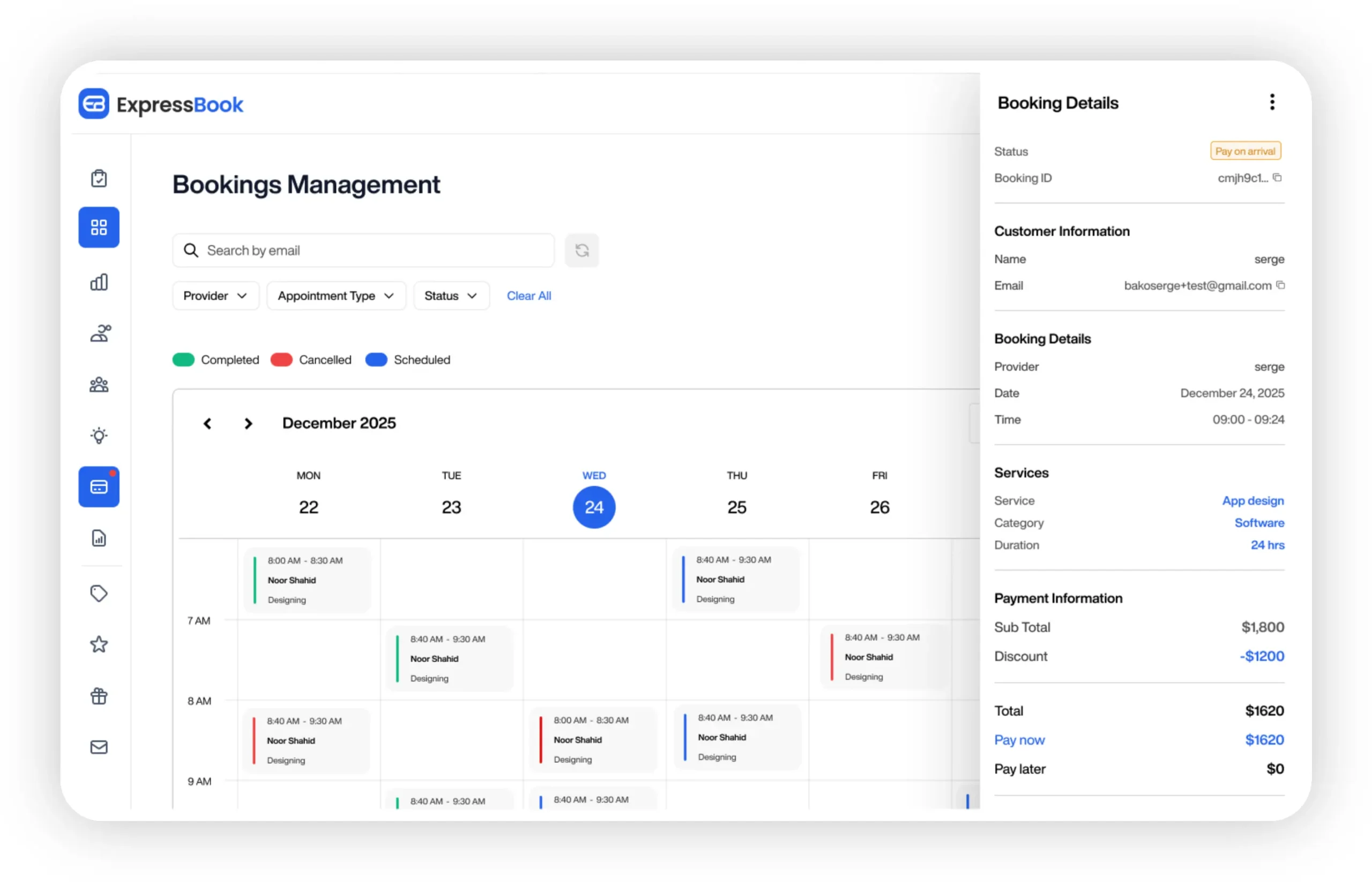
The platform includes a dedicated mobile app for for both clients and admins, so staff can approve an exception or check a refund status from the floor instead of running back to a desktop. A built-in voice agent lets visually impaired clients book appointments and ask policy questions without needing a sighted assistant. Real-time availability prevents the double-bookings that trigger provider-initiated cancellations in the first place.
ExpressBook offers up to 3 months free trial , so you can test your exact fee structure, deposit rules, and refund automation before committing. Start a free trial on ExpressBook and set your cancellation rules once, instead of explaining them one client at a time.
Sources
- Ingenico — refund timeframe FAQ
- UpCounsel — unfair contract terms and proportionality
- LegalClarity — How to word a cancellation policy