A no-show fee policy is a written rule defining when your practice charges patients for missed or late-canceled appointments, and how you enforce that charge. It applies to any patient who fails to show up or cancels outside your allowed window. The policy protects appointment slots for other patients and recovers revenue that would otherwise vanish.
Start today with three moves: set a firm cancellation window (24 to 48 hours is standard), pick a fee structure that fits your visit types, and publish the policy everywhere patients look.
- Choose a cancellation window based on visit type and demand
- Decide between a flat fee, percentage, or tiered fee model
- Publish the policy on your website, intake forms, and booking confirmations
- Turn on automated reminders and card-on-file collection before you enforce anything
Key Takeaways
A no-show fee policy only works when it pairs clear written terms with consistent enforcement and automated reminders that catch patients before they miss a visit.
| Point | Details |
|---|---|
| Define terms precisely | Separate no-show, late cancellation, and late arrival so staff apply fees consistently. |
| Match fee to visit complexity | Use flat fees for routine visits and higher tiered fees for procedures requiring prep. |
| Document consent at intake | Capture a signed or clicked policy acknowledgment to defend charges in card disputes. |
| Pilot before full rollout | Test the policy on one provider or clinic for a month and measure complaints first. |
| Automate with ExpressBook | Use ExpressBook’s reminders, card-on-file, and reporting dashboard to enforce the policy without manual tracking. |
Table of Contents
- What Counts as a No-Show Versus a Late Cancellation?
- Why Practices Need a Written No-Show Policy
- How Do You Write a No-Show Fee Policy?
- What Should Your No-Show Cancellation Policy Include?
- Enforcement and Collections: How Do You Actually Get Paid?
- Is a No-Show Fee Policy Legally Enforceable?
- How Do You Roll Out a No-Show Policy Without Backlash?
- Which KPIs Prove the Policy Is Working?
- Sample No-Show Fee Policy Templates You Can Copy
- How Scheduling Software Reduces No-Shows and Enforces Your Policy
- What Actually Determines Whether a No-Show Policy Sticks?
- Automate Your No-Show Fee Policy with ExpressBook
- Frequently Asked Questions
- Sources
What Counts as a No-Show Versus a Late Cancellation?
A no-show means the patient never contacts your office and simply doesn’t appear. A late cancellation means they notified you, but after your defined window has already closed. Most practices also define late arrival, treating anyone who shows up more than 10 to 15 minutes past their slot as a no-show, since the appointment can no longer run as scheduled.
The distinction matters because each triggers different consequences and different fee amounts in a well-built policy.
- No-show: zero notice, appointment time is completely lost
- Late cancellation: notice given, but inside a window too short to rebook the slot
- Late arrival: patient appears, but too late for the visit to proceed as planned
- Reschedule: notice given outside the cancellation window; no fee applies
A routine physical canceled two hours ahead behaves differently than a 45-minute procedure visit canceled the same way. The procedure visit likely blocked prep time, staff coordination, and equipment that a routine visit didn’t.
Why Practices Need a Written No-Show Policy
Every empty slot is a scheduling failure with a dollar amount attached. Peer-reviewed research confirms that reminder and scheduling interventions measurably cut no-show rates, which means the inverse is also true: practices without structured follow-up bleed appointment capacity they can’t get back.
By the numbers: A single missed slot doesn’t just cost one visit. It also blocks a patient who genuinely needed that time, delaying care and creating a ripple effect across your daily schedule.
Medical association guidance is direct on this point: practices should develop a no-show policy and use it consistently, rather than handling missed visits case by case.
- Blocked slots reduce access for urgent and same-week patients
- Inconsistent enforcement creates the appearance of favoritism among staff and patients
- Written policies give front-desk staff a script instead of a judgment call
How Do You Write a No-Show Fee Policy?
Draft the policy in five parts: scope, triggers, fee amount, exceptions, and appeals. Write in plain language a patient can read once and understand, not legal boilerplate that sounds punitive.
Set cancellation windows by visit complexity. A routine follow-up might allow 24 hours’ notice. A specialty consult or procedure that requires prep, equipment, or a longer block deserves 48 to 72 hours, since rebooking that slot on short notice is far harder.
For fee structure, most practices choose one of three models: a flat fee per missed visit, a percentage of the expected visit cost, or a tiered fee that scales with visit type (a $25 fee for a standard visit, $75 or more for a procedure slot). Tiered fees track the real cost of the disruption better than a flat number applied everywhere.
Pro Tip: Frame the policy around access, not punishment. Language like “this fee helps us keep appointments available for patients who need urgent care” gets far less pushback than “failure to comply will result in charges.”
- State who the policy applies to and when it takes effect
- Define the fee amount or formula by visit type
- Include a grace period and a documented exceptions list
- Spell out how a patient appeals a charge
What Should Your No-Show Cancellation Policy Include?
A defensible policy needs eight components: scope, definitions, cancellation window, fee amount or formula, grace period, exceptions, appeals process, and billing method. Skip any of these and you leave room for disputes.
- Scope: which appointment types the policy covers (in-person, telehealth, procedures)
- Definitions: no-show, late cancellation, late arrival, as covered above
- Cancellation window: hours of notice required by visit type
- Fee structure: flat, percentage, or tiered, stated in dollars
- Grace period: first-offense waiver or a documented hardship exception
- Appeals: who reviews disputes and within what timeframe
- Billing method: card-on-file, invoice, or patient portal charge
- Documentation: signed or clicked acknowledgment at intake
That single clause, paired with an appeals sentence (“Patients may request a fee waiver in writing within 14 days for documented emergencies”), covers most of what a small or mid-size practice needs.
Pro Tip: Add a checkbox to your digital intake form that reads “I have read and accept the cancellation policy,” with a timestamp captured automatically. That single click becomes your strongest evidence if a patient disputes the charge later.
Enforcement and Collections: How Do You Actually Get Paid?
Four methods dominate: card-on-file with preauthorization, automated post-visit charging, invoiced billing to the patient account, and collections as a last resort for repeated non-payment. Card-on-file with an automated charge triggered by the no-show event is the fastest and lowest-friction option for most practices.
- Detect the no-show and log the time in your scheduling system
- Document any attempt to reach the patient before or after the missed slot
- Apply the fee per your published policy, consistently
- Send a receipt and appeal instructions immediately after charging
- Keep timestamped records for every step; disputes hinge on documentation
- Train staff to apply the fee the same way for every patient, every time
- Use a PCI-compliant payment processor for any stored card data
Health-system examples confirm the standard practice here: UNC Health’s policy bills no-show fees directly to the patient account rather than submitting them to insurance, which is the norm across the industry.
Is a No-Show Fee Policy Legally Enforceable?
Yes, when three conditions are met: clear disclosure at booking, a signed or clicked acknowledgment, and consistent enforcement across similar patients. Skip any one of those and your fee becomes much harder to defend if a patient challenges the charge with their card issuer.
Insurance and Medicare generally treat no-show fees as the patient’s direct responsibility, not a billable service, so check payer-specific rules before assuming a charge is automatically allowed for every program you accept.
Practices defending a no-show card charge in a dispute need signed or electronically accepted policy acknowledgments and detailed timestamps, because card issuers frequently side with the cardholder when disclosure wasn’t explicit.
AMA ethics guidance adds a second guardrail: administrative fees must be reasonable in amount and clearly disclosed before the patient incurs them, not explained after the fact.
Pro Tip: Build a 14-day appeal window with a named human reviewer into your policy. Practices that offer a real review process see fewer credit card chargebacks than those that charge automatically with no recourse.
How Do You Roll Out a No-Show Policy Without Backlash?
Rollout has two tracks: internal readiness and patient communication. Internally, train staff, update your intake forms, adjust EHR or portal settings, and name one person who handles appeals. Externally, publish the policy on your website, in confirmation emails, on intake forms, and in reminder texts at 7 days, 48 hours, and 24 hours before each visit.
Give front-desk and billing staff a short script: “Our office has a policy that helps us keep appointments available for everyone. If you need to cancel, please let us know at least 24 hours ahead so we can offer that time to another patient.” For appeal calls: “I understand this is frustrating. Let me document your situation and send it to our review team within two business days.”
- Week 1: finalize policy language and update forms
- Week 2: train staff and configure reminder cadence
- Week 3: publish policy on all patient-facing channels
- Week 4: go live and monitor the first batch of enforced fees
- Confirm reminders fire automatically at each interval
- Track early disputes closely; adjust wording if a pattern emerges
Which KPIs Prove the Policy Is Working?
Track five numbers monthly: no-show rate, cancellation-in-window rate, fee recovery rate, revenue recovered, and patient complaint rate. No-show rate equals missed appointments divided by scheduled appointments. Recovery rate equals fees collected divided by fees billed.
- No-show rate: aim for a steady decline after rollout
- Recovery rate: a healthy target is collecting most of the billed fees
- Revenue recovered: track in dollars, not just percentage, for leadership reporting
- Complaint rate: watch this closely in month one to catch policy friction early
Review these figures monthly for the first quarter, then quarterly once the policy stabilizes.
Sample No-Show Fee Policy Templates You Can Copy
Primary care practices typically use a modest flat fee with a short window: “A $25 fee applies to no-shows or cancellations made less than 24 hours before your scheduled visit.”
Specialty and procedural visits justify a higher fee and longer notice, since prep time and equipment scheduling are harder to recover: “Procedure appointments require 48 hours’ notice. Missed or late-canceled procedure visits are subject to a $75 fee.”
Telehealth visits still need a policy line, even without a physical room to hold open: “Telehealth no-shows are subject to the same fee schedule as in-person visits, except in documented medical emergencies.”
University health services offer useful real-world reference points here. Both Purdue’s student health service and George Mason’s student health center publish short, plain-language policies with defined appeal windows that translate well to a general practice setting.
How Scheduling Software Reduces No-Shows and Enforces Your Policy
Software closes the gap between writing a policy and actually collecting on it with features explained in the Heyhive Blog — Workforce Scheduling, Attendance & Hiring Insights, helping practices improve enforcement and recovery. The core feature set includes automated multi-channel reminders, self-service reschedule links, card-on-file storage, a policy acknowledgment checkbox at booking, and a reporting dashboard that tracks recovery rates without manual spreadsheet work.

Staged reminders at 7 days, 48 hours, and 24 hours reduce missed appointments far more effectively than a single reminder sent the day before, since patients get multiple chances to reschedule before the window closes. Pairing that cadence with an easy self-cancellation link matters just as much: behavioral research on decision friction shows that small penalties combined with low-friction alternatives change patient behavior more reliably than penalties alone.
Pro Tip: Turn on the “accept policy” checkbox at the moment of booking, not at check-in. Capturing consent before the appointment exists strengthens your position if you ever need to defend a charge.
- Automated reminders at multiple intervals before each visit
- Self-cancellation and reschedule links that reduce true no-shows
- Card-on-file with secure, PCI-compliant processing
- Reporting dashboards that calculate recovery rate automatically
What Actually Determines Whether a No-Show Policy Sticks?
Consistency, not the fee amount, is what determines whether a policy holds up over time. A $75 fee applied unevenly generates more complaints than a $25 fee applied to every patient without exception. Staff need a script, not discretion, because discretion is exactly where fairness disputes start.
The most common rollout mistake is going practice-wide on day one. Start with a single provider or a single clinic location, run it for a month, and measure the complaint rate before expanding. That pilot data tells you whether your window, fee, and wording actually work, before you’ve trained an entire staff on language you’ll need to revise anyway.
Automate Your No-Show Fee Policy with ExpressBook
ExpressBook turns the policy you just wrote into an automated workflow instead of a manual chore your front desk has to remember every day. It handles the staged reminders, card-on-file storage, policy acknowledgment checkbox at booking, and reporting dashboard described throughout this guide, all synced automatically with QuickBooks and Xero so a charged fee shows up in your books without a single manual entry.
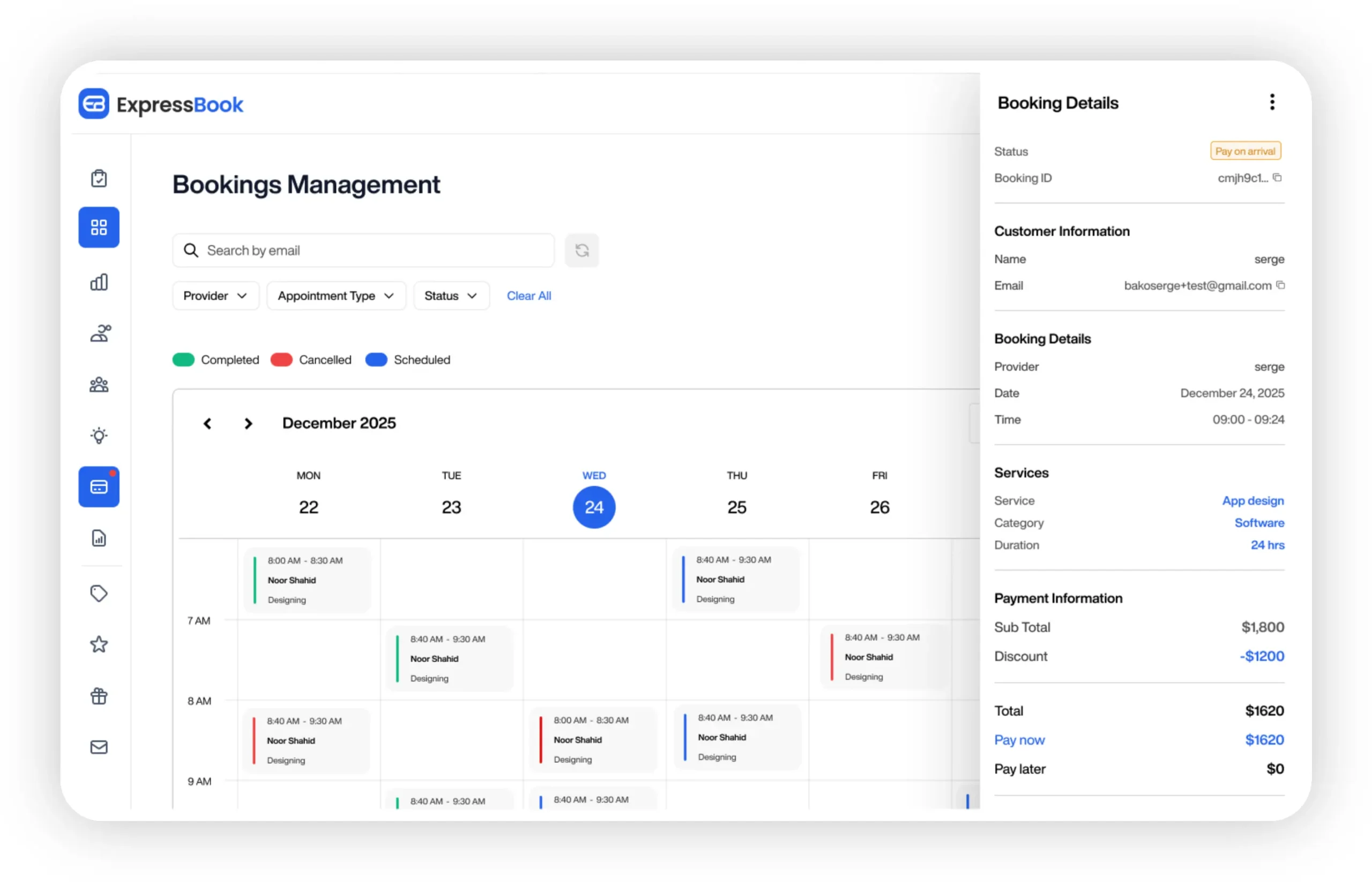
The platform also includes a dedicated mobile app for staff and administrators, plus a voice agent that lets visually impaired patients book appointments and get policy questions answered without needing a sighted assistant. If you manage multiple locations, centralized reporting across sites keeps enforcement consistent everywhere.
Expressbook offers a free trial period to test the full setup against your own no-show numbers before you commit. Start your free trial and see your recovery rate the first month.
Frequently Asked Questions
Is a no-show fee policy legal in every state?
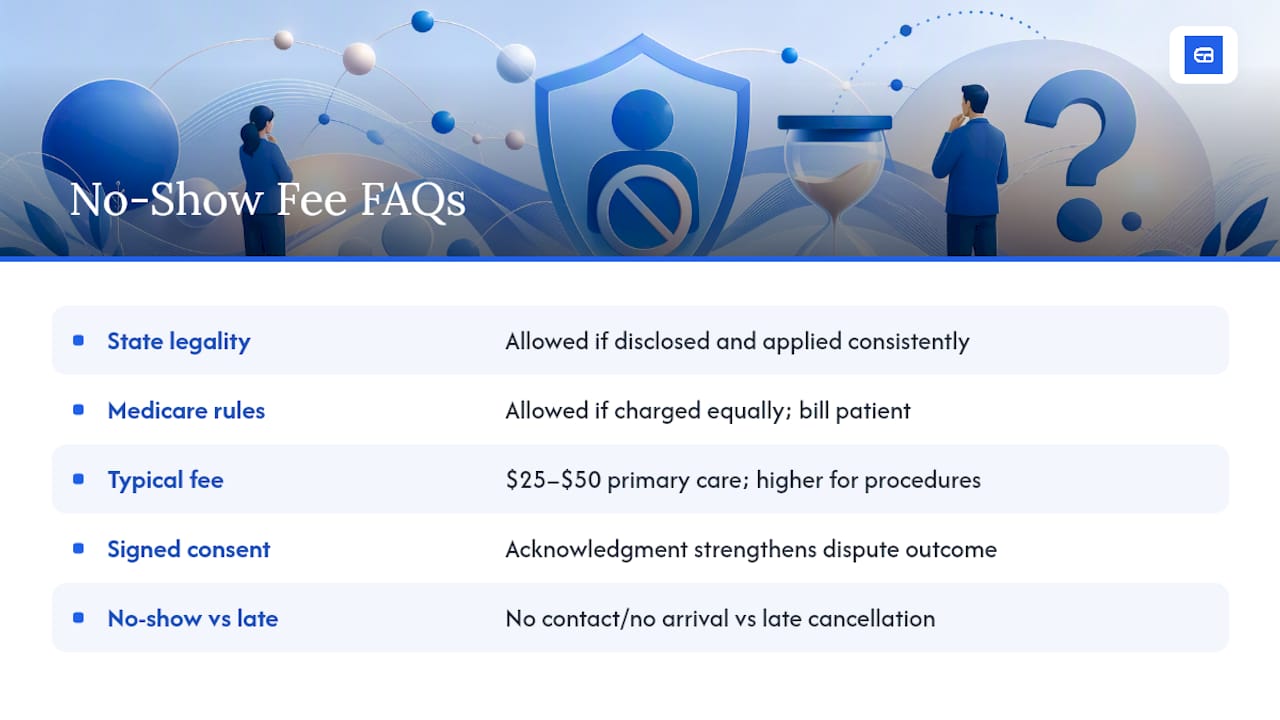
Yes, no-show fees are generally legal across the United States as long as the fee is disclosed clearly before the appointment and applied consistently. Check payer-specific rules for Medicare and Medicaid patients, since coverage of administrative fees can vary.
Can I charge a no-show fee to Medicare patients?
Medicare generally allows no-show fees as long as you charge Medicare and non-Medicare patients the same amount under the same policy, and you bill the fee to the patient directly rather than to Medicare.
How much should a no-show fee be?
Most primary care practices charge between $25 and $50 for a standard missed visit, with higher fees for procedure or specialty visits that require more prep time to rebook.
Do I need a signed form to enforce a no-show fee?
A signed or clicked acknowledgment significantly strengthens your position in a card dispute. Without documented consent, card issuers often rule in favor of the patient.
What’s the difference between a no-show and a late cancellation?
A no-show means the patient never contacted the office and didn’t arrive. A late cancellation means they gave notice, but after the required window had already closed.
This article is general information, not a substitute for advice from a qualified lawyer. Consult a qualified legal professional about your own circumstances before acting on anything here.