Tattoo appointment deposits are typically non-refundable. Studios treat the payment as compensation for the artist’s time and prep work, not a fee you get back if plans change. Common ranges run $50 to $300 for standard sessions, while full-day or multi-session bookings can require structured deposits, like $500 for a full day plus $100 per additional session. Before you send any payment, ask three things: the exact amount, the reschedule notice window, and how the deposit applies to your final bill.
- Deposit range for most single sessions: $50 to $300
- Structured deposits for full-day or multi-session work: often $500+ upfront
- Ask before paying: amount, reschedule window, application to final cost
Deposits of $100 to $200 are standard for many appointments, and most studios require at least 72 hours’ notice before rescheduling without penalty.
Key Takeaways
Tattoo appointment deposits are non-refundable in almost every standard studio policy because they compensate the artist for time, design work, and lost booking opportunities, not just a placeholder fee.
| Point | Details |
|---|---|
| Deposits are earned, not held | Most studios consider the deposit payment for prep work completed immediately after booking. |
| Typical range is $50 to $300 | Full-day or multi-session bookings often require $500 or more upfront. |
| 72-hour notice is standard | Give less notice than that and you generally forfeit the full deposit. |
| Deposits are non-transferable | You usually cannot pass your slot to another person or artist without studio approval. |
| Get it in writing | A written policy and invoice confirmation is your best protection if a dispute arises. |
Studio Policies Worth Comparing to Your Own Booking
- Classic Ink Tattoo Studio: strict forfeiture language tied to short-notice cancellations
- Folklore Tattoo: deposit ranges applied directly toward final cost
- Anatomy Tattoo: clear 72-hour reschedule requirement
- Korl Tattoo: structured multi-session deposit model
- The Point Tattoo: straightforward deposit-to-appointment-length examples
Compare these clauses against whatever policy your own studio hands you before you pay.
Table of Contents
- What Does a Tattoo Deposit Actually Cover?
- How Much Should You Expect to Pay?
- What Are the Rules for Refunds, Reschedules, and No-Shows?
- How Do You Pay a Deposit, and Can You Transfer It?
- What Should You Ask Before Paying, and What Are the Red Flags?
- Why Do Artists Insist on Non-Refundable Deposits?
- Frequently Asked Questions
- Sources
What Does a Tattoo Deposit Actually Cover?
A tattoo deposit is a partial payment that reserves your artist’s time slot and immediately kicks off preparatory work behind the scenes. The moment you pay, most artists start blocking off their calendar, sketching concepts, and turning down other clients who wanted that same window. That’s the reasoning studios lean on when they call the deposit “earned” rather than “held.”
Deposits commonly cover:
- The artist’s blocked calendar time, even if you cancel
- Custom design work, including concept sketches and revisions
- Consultation time spent discussing placement, size, and style
- The opportunity cost of turning away other clients for that slot
Here’s a scenario worth picturing: you pay a $150 deposit on Monday, and by Wednesday your artist has already drafted two design concepts based on your reference photos. If you cancel Thursday, that design work doesn’t un-happen. The studio’s position is straightforward: the deposit already paid for hours that were spent, not hours that are still owed.
How Much Should You Expect to Pay?
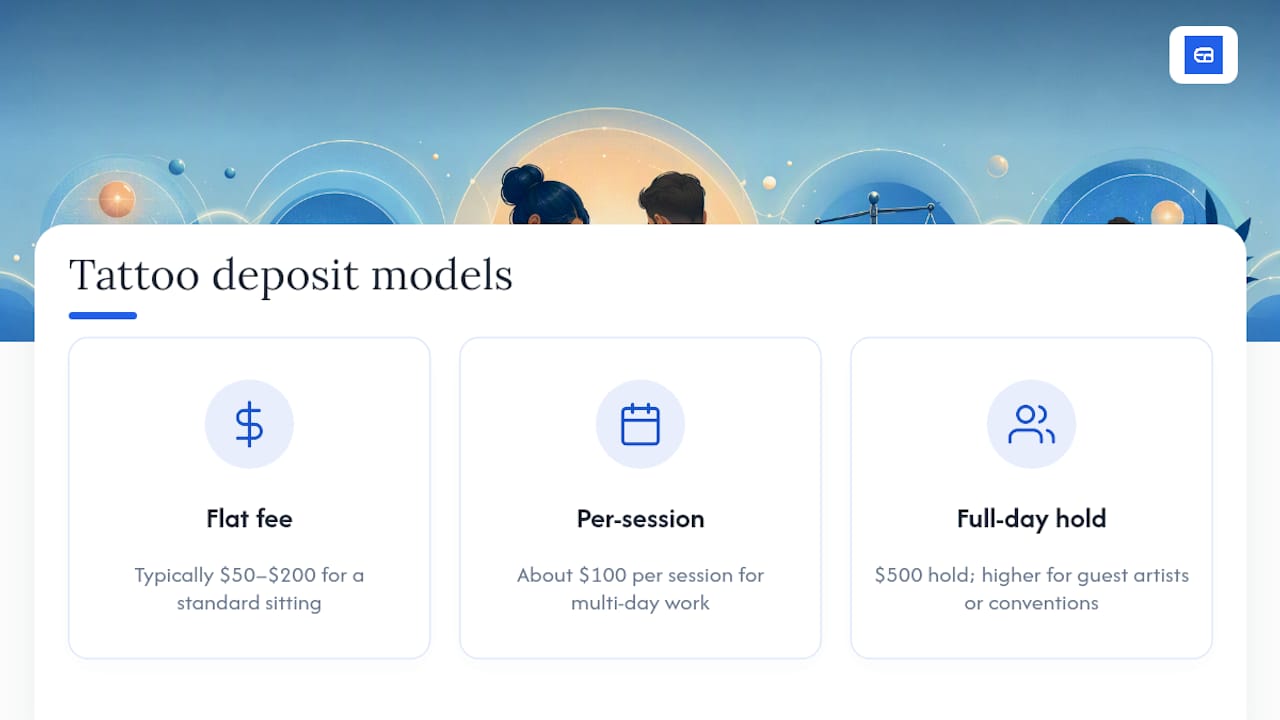
Deposit amounts vary by studio, but three models dominate the industry. Flat fees are the most common, typically $50 to $200 for a standard sitting. Per-session deposits show up on multi-day work, where you might pay $100 per session or a $500 hold for a full-day booking.
Expect higher deposits when booking a touring guest artist, a full-day sitting, or a slot during a busy convention weekend. Demand for those calendar spots is higher, and studios protect against last-minute cancellations accordingly. If a quoted deposit feels unusually high for the work involved, ask the studio to break down what it covers. A deposit that runs $80 to $300 and applies directly to your final cost is a normal, fair range for most standard bookings.
What Are the Rules for Refunds, Reschedules, and No-Shows?
Most studios build their deposit policy around notice windows. Give enough lead time and you keep your deposit intact for a rescheduled date. Miss that window and the deposit is typically gone.
Typical rules look like this:
- 72-hour notice is the most common minimum for rescheduling without losing your deposit.
- 48-hour notice appears at some studios, especially for shorter, single-session appointments.
- No-shows forfeit the deposit entirely, with no exceptions in almost every policy reviewed.
- Repeated reschedules often trigger forfeiture after the first or second move, even with proper notice.
- Tardiness beyond a set limit, often 15 to 30 minutes, can count as a no-show under some policies.
A studio’s written terms usually spell out exactly what causes forfeiture. Classic Ink Tattoo Studio’s policy, for example, lists short-notice reschedules, no-shows, excessive tardiness, and last-minute design overhauls as forfeiture triggers. Some studios also require a fresh deposit before you can rebook after forfeiting the first one, essentially resetting the clock on your spot in line.
Multi-session bookings often come with tighter guardrails. Korl Tattoo’s structured deposit policy limits clients to one or two reschedules total and requires the new date be set within 30 days, so the booking doesn’t sit open indefinitely.
Pro Tip: Screenshot the studio’s deposit policy page, save your invoice or payment confirmation email, and note the date you paid. If a dispute ever comes up over a forfeited deposit, that paper trail is what protects you.
How Do You Pay a Deposit, and Can You Transfer It?
Studios accept deposits through a mix of cash, emailed invoices, and digital payment apps. Many send invoices through booking platforms, and some studios use Venmo, PayPal, or Stripe alongside traditional invoicing to lock in a time slot.
Your deposit gets credited toward the final cost of the tattoo, usually applied to the last session if the work spans multiple sittings. Always ask for a written invoice line that states the deposit amount and confirms it will apply to your total. Get that in an email or text, not just a verbal promise at the counter.
Transferability is where people get tripped up. Most studios treat deposits as non-transferable between people or artists, meaning you generally can’t hand your slot to a friend or swap it to a different artist without the studio’s approval. A few studios allow exceptions at their discretion, but don’t assume that flexibility exists unless it’s written into the policy.
What Should You Ask Before Paying, and What Are the Red Flags?
Run through these six questions before you send a dime:
- What is the exact deposit amount, and does it apply to my final cost?
- What is the refund policy if I need to cancel?
- How much notice do I need to give to reschedule without losing the deposit?
- Can the deposit transfer to another person or artist?
- What happens to my deposit if the studio or artist cancels on me?
- Will I receive written confirmation of my appointment date, time, and deposit amount?
Watch for these warning signs. A studio with no written deposit policy, only a verbal explanation, is asking you to trust an unwritten rule that can shift after you’ve paid. Requests for full payment upfront with no invoice or receipt are another concern, since you’ll have nothing to point to if the appointment falls through. If different staff members give you conflicting answers about the same policy, that inconsistency alone is worth pausing over.
Pro Tip: Don’t send payment until you have a written policy or confirmation email in hand. A legitimate studio will have this ready before you ask twice.
Why Do Artists Insist on Non-Refundable Deposits?
Independent tattoo artists run their calendars the way freelancers run any project-based business: booked time that goes unused is income that’s simply gone. A canceled slot with no notice often can’t be refilled on short notice, which means the artist absorbs the full financial hit of that block of hours.
Deposits act as a financial safeguard for artists, converting a loosely held verbal booking into a binding commitment that offsets income lost to last-minute cancellations and no-shows.
That’s the core reasoning behind why tattoo artists take deposits in the first place. Picture an artist who blocks off a half-day session, roughly four hours at their standard hourly rate. A no-show at that scale isn’t a minor inconvenience. It’s real, unrecoverable revenue. A fair policy cuts both ways: reasonable notice windows, clear reschedule rules, and a refund if the studio itself has to cancel.
One Thing to Do Before You Pay Any Deposit
The single best move you can make is getting the studio’s deposit policy and your booking confirmation in writing before you pay anything. I’d also set a calendar reminder a few days ahead of that reschedule notice window, so you’re never caught off guard by a forfeiture rule you forgot about.
For studio owners managing this on the operations side, the same discipline that protects clients protects your business, and a QR code waitlist can help efficiently manage last-minute openings as a complement to deposit policies. A scheduling platform built for tattoo and piercing studios automates deposit collection, applies payments to invoices, and syncs everything with QuickBooks or Xero so nothing falls through the cracks at month’s end. Expressbook also runs a voice agent so clients booking by phone, including visually impaired clients, get the same clear answers about deposit terms as anyone using the app. Studios can test the full setup with up to three months free before committing to a plan, through the Expressbook platform, available on both web and a dedicated mobile app for staff and clients alike. If you’re weighing options for your business, this guide to choosing scheduling software walks through what to prioritize.
Frequently Asked Questions
Are tattoo deposits ever refundable?
Rarely, and usually only if the artist or studio cancels your appointment and can’t reschedule you. Client-initiated cancellations almost never get a refund.
How much should a tattoo deposit be?
Most single-session deposits fall between $50 and $300. Multi-session or full-day bookings often start at $500 and add per-session fees on top.
Can I transfer my deposit to a friend or family member?
Generally no. Studios treat deposits as tied to you specifically, though some make exceptions at their discretion.
What happens if I’m late to my tattoo appointment?
Many policies treat tardiness beyond 15 to 30 minutes as a no-show, which forfeits the deposit under most studio terms.
Does my deposit count toward the final tattoo price?
Yes, in nearly every case. The deposit is applied to your final invoice, usually credited during your last session if the work spans multiple visits.
How much notice do I need to reschedule without losing my deposit?
Most studios require 48 to 72 hours’ notice. Anything less typically results in forfeiture.
Sources
- Deposit & Billing Policy | Classic Ink Tattoo Studio
- Deposit Policy – Folklore Tattoo
- Tattoo Deposit Policy & Terms | Anatomy Tattoo
- Deposit Policy – Korl Tattoo
- Deposits | The Point Tattoo