
A booking cash flow forecast tracks money in and out based on when clients book, pay deposits, and settle balances, not when you invoice or recognize revenue. The immediate fix for most service businesses is starting a rolling trigger schedule this week: a simple log that ties every booking to its deposit date, cut-off date, and service date. That single change exposes the timing gaps between what you’ve sold and what’s actually sitting in your bank account.
TL;DR:
- A trigger-based cash flow forecast tracks client payments at booking milestones, revealing timing gaps that impact actual cash availability.
- Accurate inputs include settlement lag, refunds, chargebacks, and operating outflows, which prevent overestimating cash position.
- Building a rolling 13-week forecast involves mapping booking triggers to specific cash dates and using scenario planning for seasonal fluctuations.
- Manual data entry often causes inaccuracies; integrating booking and payment platforms with accounting software automates updates and improves reliability.
- Implementing a simple trigger schedule within the first 90 days can prevent cash crunches during growth by capturing real-time receipt timing.
Table of Contents
- What Is a Booking Cash Flow Forecast and Why Does It Matter?
- What Goes Into a Booking Cash Flow Forecast?
- How Do You Build a Trigger-Based Cash Flow Forecast?
- What Does a Booking Cash Flow Forecast Template Look Like?
- How Do Seasonal Booking Patterns Affect Cash Flow?
- What Are the Most Common Forecasting Mistakes?
- How Do Booking Platforms and Accounting Syncs Cut Forecasting Work?
- Your First 90 Days: An Implementation Checklist
- Why Booking-Aware Forecasting Matters More as You Scale
- Where to Learn More About Cash Flow Forecasting
- Sources
What Is a Booking Cash Flow Forecast and Why Does It Matter?
Revenue recognition tells you what you earned. Cash timing tells you what you can actually spend, and for salons, studios, clinics, and gyms, those two numbers rarely line up. A client who books a $2,000 package in March might pay a 20% deposit now, another chunk at a cut-off date, and the rest the day of service, weeks or months later. If you plan payroll and rent around the booking total instead of the actual receipt dates, you’re forecasting a number that doesn’t exist yet.
Most service businesses that sell in advance encounter a similar payment structure:
- A deposit collected at booking, typically ranging from 20 to 25% of the total.
- An interim payment due at a defined cut-off date, often bringing cumulative collections to 50 to 75% of the total.
- A final balance settled on or near the service date itself.
This is where a trigger schedule earns its place. Instead of a static monthly cash projection, you build a schedule that fires a cash entry every time a booking crosses one of these milestones. J.P. Morgan’s guidance on cash forecasting recommends exactly this kind of milestone based modeling over relying on revenue recognition timing, and it’s the difference between guessing and knowing when cash actually lands.
What Goes Into a Booking Cash Flow Forecast?
A forecast is only as good as its inputs. Skip a line item and you’ll get a number that looks precise but misses the cash event that actually breaks your month.
Start with the foundation:
- Opening balance. Your actual bank balance at the start of the period, adjusted for items still clearing (checks written but not cashed, pending card settlements).
- Booking receipts by milestone. Deposits, interim cut-off payments, and final balances, each tied to a specific date rather than a booking month.
- Refunds and chargebacks. Cancellation policies determine how much of a deposit you actually keep; build a realistic attrition rate into your receipts line rather than assuming every booking pays in full.
- Settlement lags. Card processors typically hold funds for one to three business days before depositing them. That lag matters when you’re forecasting week to week, not just month to month.
- Operating outflows. Payroll, rent, supplier payments, and software subscriptions, each mapped to its actual due date.
- Payroll and tax timing. Payroll tax deposits and quarterly estimated payments often fall in the same week as a slow booking period. That collision is exactly what a good forecast is supposed to catch.
- One off events. Equipment purchases, lease renewals, or annual insurance premiums that don’t recur monthly but hit hard when they land.
Missing any of these doesn’t just shrink the forecast’s accuracy; it removes the specific line that would have warned you about a cash crunch three weeks before it hit. J.P. Morgan’s midsize business guide to cash forecasting frames this kind of disciplined input list as a strategic tool for funding growth decisions, not just a reporting exercise you run once a month and file away.
How Do You Build a Trigger-Based Cash Flow Forecast?
Building the forecast is a sequence, not a single spreadsheet exercise. Get the structure right first, then populate it.
- Choose your horizon and cadence. Run a rolling 13-week view for operational liquidity, updated weekly, alongside a 6 or 12-month scenario forecast updated monthly for planning and capital decisions. The Trezy cash flow simulator is built around this same dual-horizon logic, pairing a short operational window with a longer planning view.
- Map booking triggers to specific cash dates. For each booking type, define when the deposit posts (often T-90 or T-120), when the cut-off payment is due (T-30 to T-45), and when the balance clears on the service date.
- Decide between direct and indirect methods. The direct method, tracking actual expected receipts and disbursements by date, works best for the 13-week operational view. The indirect method, adjusting net income for non-cash items, suits the longer planning horizon where booking-level detail gets noisy.
- Pull your data sources. Export booking records from your scheduling system, settlement reports from your payment processor, and your payroll calendar. Reconcile all three against the same date range before you build a single formula.
- Layer in scenarios. Build a base case, a best case, and a worst case that assumes a higher cancellation rate. Service businesses that skip this step are often the ones surprised when a slow month coincides with a payroll tax deposit.
Pro Tip: Build your cancellation sensitivity as a single adjustable percentage at the top of your spreadsheet, then let it flow through every deposit and balance line automatically. That one cell turns a static forecast into a live stress test.
What Does a Booking Cash Flow Forecast Template Look Like?
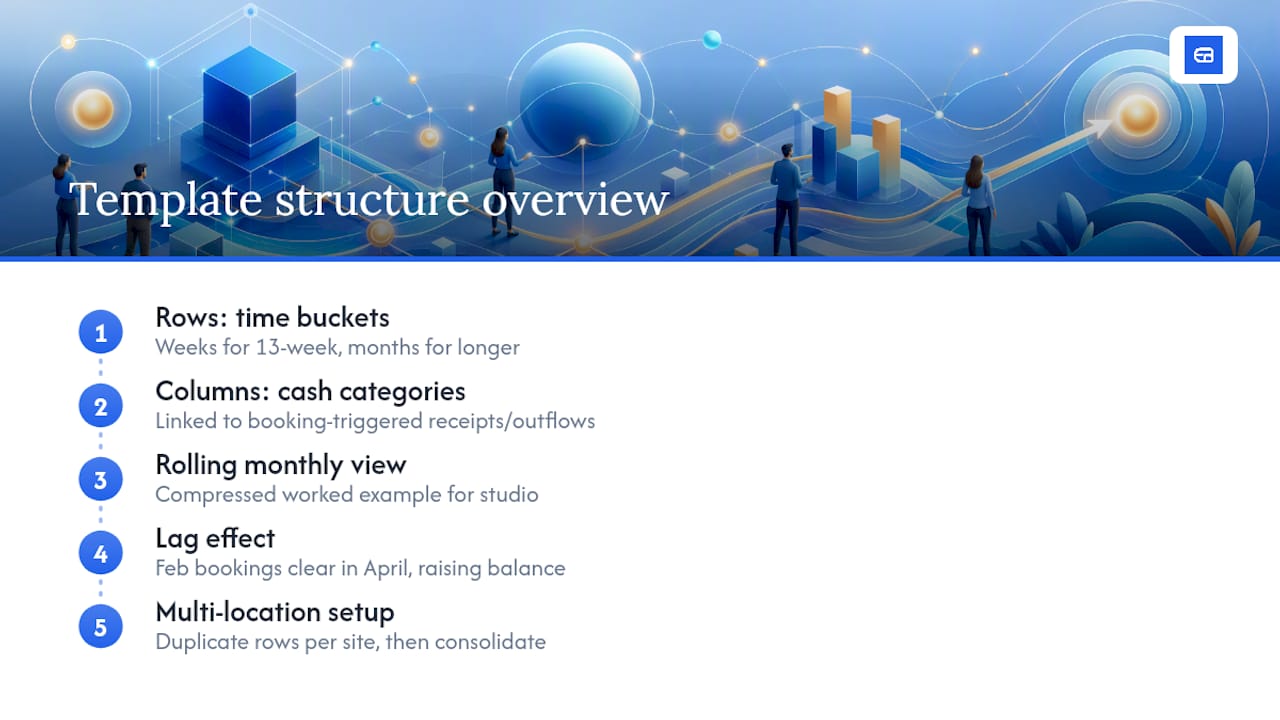
A usable template is simpler than most spreadsheets make it look. Rows represent time buckets (weeks for the 13-week view, months for the longer horizon), and columns represent cash categories tied to booking triggers.
Here’s a compressed worked example for a mid-sized studio running a rolling monthly view:
Notice April’s closing balance climbs even though payroll stayed flat. That’s the cut-off payments from bookings made back in February finally clearing, exactly the kind of lag a revenue-based forecast would have missed entirely.
For single-location businesses, this template runs as one sheet. Multi-location operators should duplicate the receipts and outflow rows per location, then roll them up into a consolidated tab so a shortfall at one site doesn’t quietly drain cash meant for another. The FlowCast tool offers a similar visual layout with export options if you’d rather start from a built template than a blank sheet.
How Do Seasonal Booking Patterns Affect Cash Flow?
Service businesses with strong seasonal demand run into what’s often called the two-humped cash cycle: bookings pile up in a concentrated window, but the expenses required to deliver those services (staffing, supplies, facility costs) often peak on a delayed or offset schedule. The result is a business that looks flush during peak booking season and stretched thin a few months later when the bills for that same season come due.
Some seasonal service and retail businesses generate as much as 50% of annual revenue in just 16 weeks, which means the other roughly eight months have to be funded from cash accumulated during that narrow window.
A few tactics smooth this out:
- Tighten deposit policies during peak booking months so more cash arrives up front, rather than trailing into the slow season.
- Set a reserve target, a specific dollar amount held back from peak-season receipts, before touching that cash for anything else.
- Stagger payouts to contractors or stylists on commission rather than paying everything on a fixed monthly schedule that ignores when cash actually arrived.
- Consider short-term credit lines as a backstop, not a habit, to bridge planned low-cash months you’ve already identified in your forecast.
Modeling accumulation means adding a specific reserve line to your monthly forecast during high-booking months, one that only gets released against pre-approved off-season expenses.
What Are the Most Common Forecasting Mistakes?
Most forecasting errors come from convenience, not carelessness. Building the model around whatever number is easiest to pull is the exact habit that makes the forecast wrong.
- Using revenue instead of cash timing. Logging a $5,000 booking as March income when only a $1,000 deposit actually landed in March overstates the month and understates whatever month the balance is due.
- Ignoring processor settlement lag. A one to three day delay sounds trivial until it pushes a Friday deposit into the following week, right when a Monday payroll run is scheduled.
- Treating growth as automatically good for cash. Rapid booking growth often means hiring and supply costs land before the corresponding final payments clear, a liquidity trap that Burke & Herbert Bank’s guidance on avoiding cash flow crises flags as a common trigger for growth-stage cash shortfalls.
Validate the forecast the same way you’d validate any financial model: reconcile bank and settlement records against your predicted receipts weekly, and run a variance analysis comparing forecast to actual at least monthly. Assign one person ownership of the update cadence.
Pro Tip: Color-code variance over 10% in your spreadsheet. A single red cell tells you faster than a paragraph of notes that a booking trigger didn’t fire the way you expected.
How Do Booking Platforms and Accounting Syncs Cut Forecasting Work?
Manual data entry is where most booking forecasts quietly fall apart, not because the model is wrong, but because nobody keeps feeding it accurate numbers. Integration closes that gap.
The essentials to look for:
- A direct sync with QuickBooks or Xero, so deposits, refunds, and final payments post to your books without a spreadsheet in between.
- Automatic capture of settlement lag, so your forecast reflects when funds actually clear, not when the booking was made.
- Deposit and refund flags built into the booking record itself, so a cancellation updates your cash projection instead of sitting as an open item someone has to chase down.
Expressbook syncs scheduling, payments, and client records directly with QuickBooks and Xero, which removes the manual re-entry that causes most reconciliation headaches at month end. Booking triggers, deposits, cut-off payments, and final balances flow into the accounting side automatically, giving you real-time visibility into receipts rather than a reconstruction job every 30 days. The platform includes a dedicated mobile app for both staff and administrators, plus a voice agent that lets visually impaired clients book appointments and get answers to business questions without needing a sighted assistant. Businesses that want to test whether this kind of automation actually saves the hours it promises can do so with Expressbook’s 3-month free trial before committing to a plan.
Your First 90 Days: An Implementation Checklist
Getting a booking cash flow forecast running doesn’t require a finance degree. It requires six specific actions, done in order.
- Set your true opening balance and assign one person as the data owner.
- Export current booking triggers and map each one to its actual cash date.
- Stand up a weekly reconciliation habit alongside a rolling 13-week cash view.
- Save base, best, and worst case scenario templates you can reuse every month.
- Agree on a reserve policy and define escalation triggers if cash dips below it.
- Put a recurring monthly review on the calendar to update stakeholders and adjust assumptions.
None of these steps take more than an afternoon individually, but skipping any one of them is usually why a forecast gets abandoned by month three.
Why Booking-Aware Forecasting Matters More as You Scale
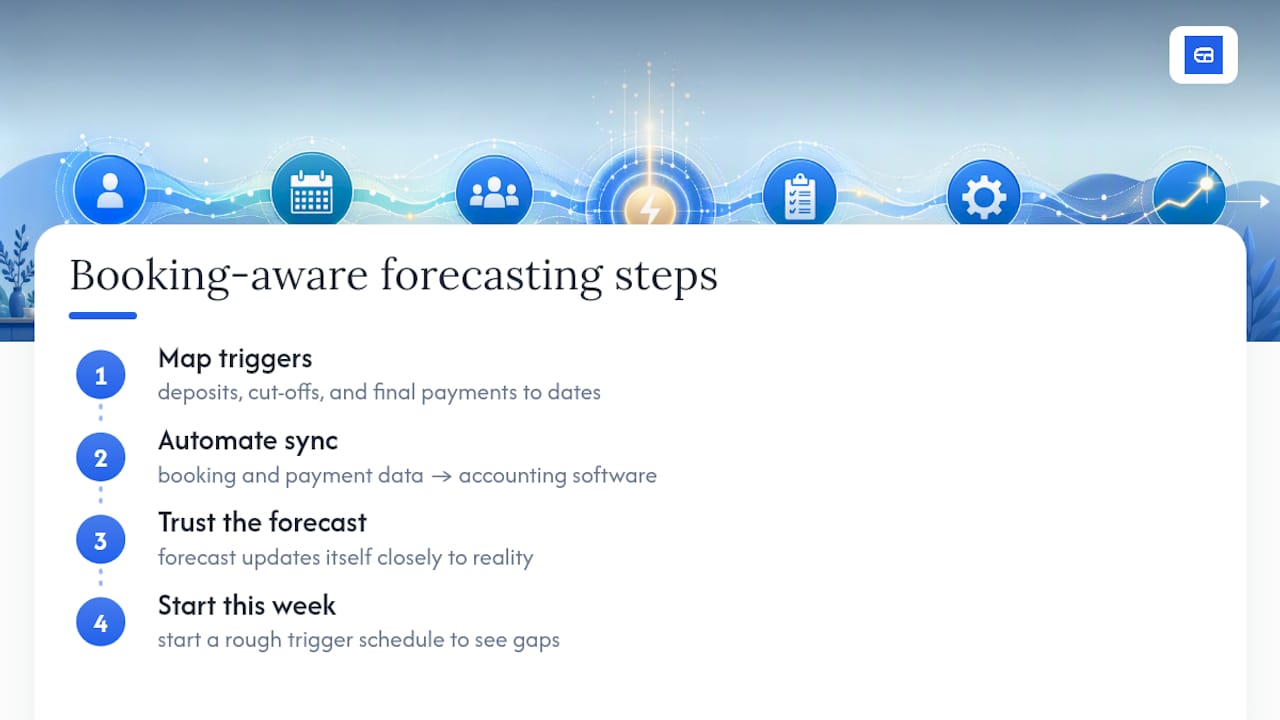
The businesses that get burned by cash flow surprises are rarely the ones standing still. They’re the ones growing fast enough that booking volume outpaces the team’s ability to track when that volume actually turns into cash. A trigger schedule sounds almost too simple to matter, mapping deposits, cut-offs, and final payments to real dates, but that simplicity is exactly why it works when spreadsheets built around monthly revenue totals don’t.
Automation tools that sync booking and payment data directly into accounting software remove the excuse of “we didn’t have time to update it.” That’s really what this comes down to: not a smarter formula, but a forecast that updates itself closely enough to reality that you trust the number on the screen. Start the trigger schedule this week, even a rough version, and you’ll see the timing gaps before they become a payroll problem instead of after.
— serge
Where to Learn More About Cash Flow Forecasting
For readers who want to go deeper on the mechanics covered here, a few resources are worth bookmarking. J.P. Morgan’s cash forecasting guide remains one of the clearer breakdowns of milestone-based modeling for businesses that collect payments in stages. Owners running highly seasonal operations should read Merchant Growth’s guide to running a seasonal business for a deeper look at reserve planning.
If you’d rather start from a working template than a blank sheet, both the Trezy simulator and FlowCast offer free scenario-based builders. For a broader look at cash visibility tools built for smaller operations, TradeTally’s guide for sole traders is a useful companion read, and Expressbook’s own booking analytics guide walks through which metrics feed directly into a forecast like the one built above.
Sources
- Cash forecasting tips for your business — J.P. Morgan
- Running a seasonal business — Merchant Growth
- Free Cash Flow Forecast Simulator | Trezy
- FlowCast: Free Cash Flow Forecasting Tool for Small Businesses